
Four full papers are submitted to ACM SUI 2019 and now under review.
Uncategorized
Two conference papers accepted at IEEE ISMAR 2019
Congratulations! We have two conference papers accepted at IEEE ISMAR 2019.
• Austin Erickson, Ryan Schubert, Kangsoo Kim, Gerd Bruder, Gregory F. Welch, “Is It Cold in Here or Is It Just Me? Analysis of Augmented Reality Temperature Visualization for Computer-Mediated Thermoception,” Proceedings of the IEEE International Symposium on Mixed and Augmented Reality, 9 pages, 2019.
• Nahal Norouzi, Kangsoo Kim, Myungho Lee, Ryan Schubert, Austin Erickson, Jeremy Bailenson, Gerd Bruder, Gregory F. Welch, “Walking Your Virtual Dog: Analysis of Awareness and Proxemics with Simulated Support Animals in Augmented Reality,” Proceedings of the IEEE International Symposium on Mixed and Augmented Reality, 11 pages, 2019.
The manuscripts will be added soon in our list of publications.
One journal article has been published at the Elsevier Computers and Graphics (CAG) journal.
An extended submission of our “Blowing in the Wind” paper, which received the Honorable Mention Award at ICAT-EGVE 2018, has been published at the Elsevier Computers & Graphics (CAG) journal (IF 2018: 1.302).
Kangsoo Kim; Ryan Schubert; Jason Hochreiter; Gerd Bruder; Gregory Welch
“Blowing in the Wind: Increasing Social Presence with a Virtual Human via Environmental Airflow Interaction in Mixed Reality Journal Article”
In: Elsevier Computers and Graphics, 83 (October 2019), pp. 23-32, 2019.
XR Advance, now with Episode Guides
XR ADVANCE: AN EXTENDED REALITY VIDEO SERIES
Was hosted by Dr. Stephen Gilbert and the Virtual Reality Applications Center at Iowa State University, XR Advance welcomed extended reality experts to present innovative research in a series of videos.
Dr. Welch was invited to be one of the extended reality experts to present. His presentation on “Identifying User Physical States” can be viewed here, it was Episode 8 in the series.
Jason Hochreiter defended his PhD in Computer Science on June 24, 2019
FINAL ORAL EXAMINATION
OF
Jason Hochreiter
BS, University of Central Florida, 2011
MS, University of Central Florida, 2014
for the degree of
DOCTOR OF PHILOSOPHY
IN COMPUTER SCIENCE
June 24, 2019, 11:00 AM
Partnership III 233
Dissertation Committee:
Dr. Gregory Welch, Chairman welch@ucf.edu
Dr. Juan Cendan Juan.Cendan@ucf.edu
Dr. Laura Gonzalez Laura.Gonzalez@ucf.edu
Dr. Joseph LaViola Jr. jjl@cs.ucf.edu
Dr. Gerd Bruder Gerd.Bruder@ucf.edu
DISSERTATION RESEARCH IMPACT
The flat screens of today’s smartphones allow for integrated electronic touch sensing. Such electronic touch sensing methods are impractical to implement on non-planar rear-projection displays. This dissertation introduces a generalizable camera-based method for touch input on such rear-projection displays, allowing for touch interactions with complex virtual content registered to the surfaces. In a human-subject study, we demonstrate several advantages of this paradigm compared to others, including improved touch performance and decreases in cognitive load. We are particularly inspired by patient care: despite the importance of touch for both diagnostic and therapeutic purposes, modern high-fidelity mannequins and other patient simulators are typically unable to naturally respond to touch input, which can limit the effectiveness of training. Our research focuses on supporting touch input in a general way, making it suitable for patient simulation and other applications.
SELECTED PUBLICATIONS & PATENTS
Touch sensing on non-parametric rear-projection surfaces: A physical-virtual head for hands-on healthcare training, Jason Hochreiter, Salam Daher, Arjun Nagendran, Laura Gonzalez, Greg Welch, in Proceedings of IEEE Virtual Reality, 2015.
Optical touch sensing on non-parametric rear-projection surfaces for interactive physical-virtual experiences, Jason Hochreiter, Salam Daher, Arjun Nagendran, Laura Gonzalez, Greg Welch, in Presence: Teleoperators and Virtual Environments, 2016.
A systematic survey of 15 years of user studies published in the intelligent virtual agents conference, Nahal Norouzi, Kangsoo Kim, Jason Hochreiter, Myungho Lee, Salam Daher, Gerd Bruder, Greg Welch, in Proceedings of the 18th ACM International Conference on Intelligent Virtual Agents, 2018.
Physical-virtual agents for healthcare simulation, Salam Daher, Jason Hochreiter, Nahal Norouzi, Laura Gonzalez, Gerd Bruder, Greg Welch, in Proceedings of the 18th ACM International Conference on Intelligent Virtual Agents, 2018.
Cognitive and touch performance effects of mismatched 3D physical and visual perceptions, Jason Hochreiter, Salam Daher, Gerd Bruder, Greg Welch, in Proceedings of IEEE Virtual Reality, 2018.
Optical touch sensing on non-parametric rear-projection surfaces, Jason Hochreiter, in Proceedings of IEEE Virtual Reality, 2018.
Patents:
2014, System for Detecting Sterile Field Events and Related Methods, 9808549B2
DISSERTATION
Multi-touch detection and semantic response on non-parametric rear-projection surfaces
Modern interfaces supporting touch input are ubiquitous. Typically, such interfaces are implemented on integrated touch-display surfaces with simple geometry that can be mathematically parameterized, such as planar surfaces and spheres; for more complicated non-parametric surfaces, such parameterizations are not available. In this dissertation, we introduce a method for generalizable optical multi-touch detection and semantic response on uninstrumented non-parametric rear-projection surfaces using an infrared-light-based multi-camera multi-projector platform.
In this paradigm, touch input allows users to manipulate complex virtual 3D content that is registered to and displayed on a physical 3D object. Detected touches trigger responses with specific semantic meaning in the context of the virtual content, such as animations or audio responses. The broad problem of touch detection and response can be decomposed into three major components: determining if a touch has occurred, determining where a detected touch has occurred, and determining how to respond to a detected touch. Our fundamental contribution is the design and implementation of a relational lookup table architecture that addresses these challenges through the encoding of coordinate relationships among the cameras, the projectors, the physical surface, and the virtual content. Additionally, we present and evaluate two algorithms for touch detection and localization utilizing the lookup table architecture.
We demonstrate touch-based interactions on several physical parametric and non-parametric surfaces, and we evaluate both system accuracy and the accuracy of typical users in touching desired targets on these surfaces. In a formative human-subject study, we present an exploratory application of this method in patient simulation. A second study highlights the advantages of touch input on content-matched physical surfaces achieved by our method, such as decreases in induced cognitive load, increases in system usability, and increases in user touch performance.
SELECTED AWARDS & HONORS:
2012, UCF Presidential Doctoral Fellowship
2018, IEEE Virtual Reality Doctoral Consortium
2018, Graduate Travel or Presentation Fellowship
One paper accepted at Elsevier Computers & Graphics Journal
An extended submission of our “Blowing in the Wind” paper, which received the Honorable Mention Award at ICAT-EGVE 2018, gets accepted at the Elsevier Computers & Graphics journal.
Congratulations to our SREAL PhD Graduate Myungho Lee
Congratulations to Myungho Lee, who graduated on May 2 with his PhD in Computer Science.
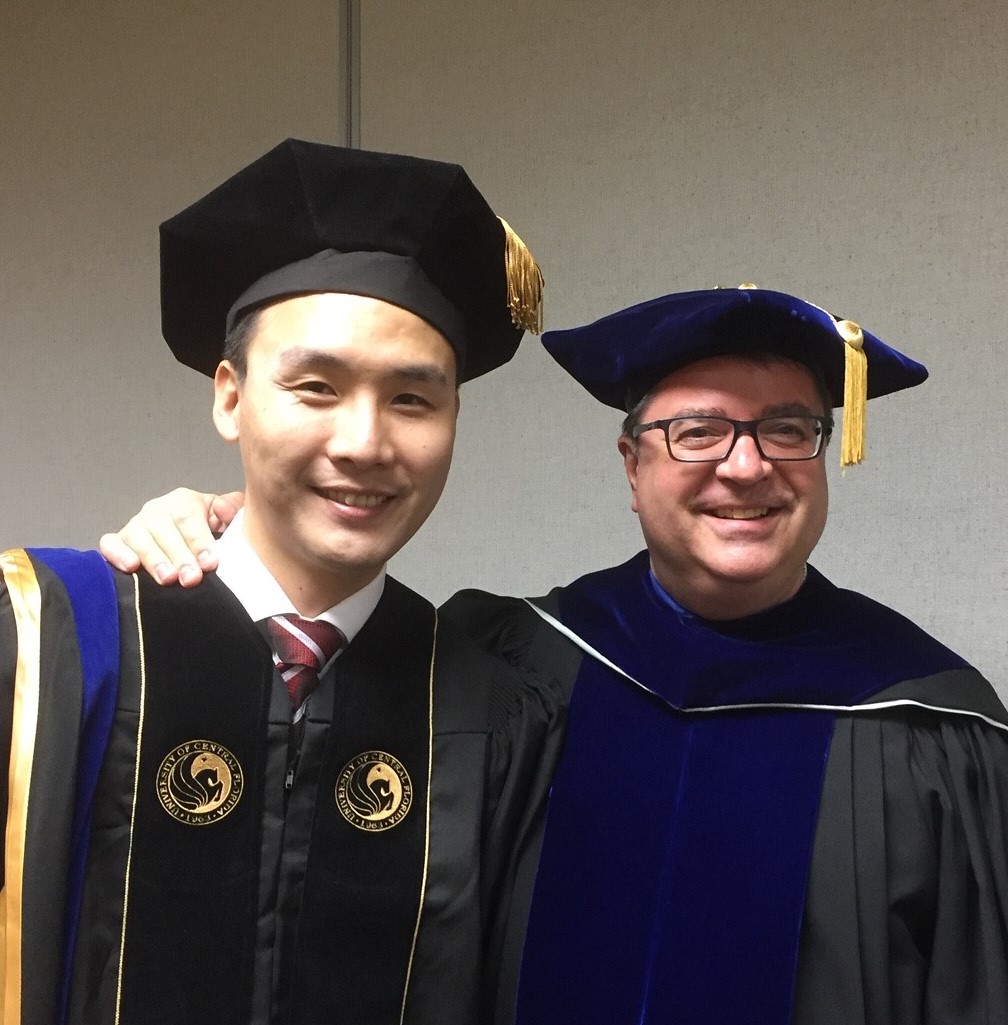
Myungho Lee defended his PhD in Computer Science on April 2, 2019.
- Time & Location: April 2, 2019 at 10:00 AM in University Tower 650A
- Title: Mediated Physicality: Inducing Illusory Physicality of Virtual Humans via Their Interactions with Physical Objects
- The term virtual human (VH) generally refers to a human-like entity comprised of computer graphics and/or physical
body. In the associated research literature, a VH can be further classified as an avatar-a human-controlled VH, or an
agent-a computer-controlled VH. Because of the resemblance with humans, people naturally distinguish them from
non-human objects, and often treat them in ways similar to real humans (RHs). Sometimes the people develop a sense
of co-presence or social presence with the VH-a phenomenon that is often exploited for training simulations where the
VH assumes the role of a human.
Prior research associated with VHs has primarily focused on the realism of various visual traits, e.g., appearance, shape,
and gestures. However, our sense of the presence of other humans is also affected by other physical sensations
conveyed through nearby space or physical objects. For example, we humans can perceive the presence of other
individuals via the sound or tactile sensation of approaching footsteps, or by the presence of complementary or opposing
forces when carrying a physical box with another person.
In my research, I exploit the fact that these sensations, when correlated with events in the shared space, affect one’s
feeling of social/co-presence with another person. In this dissertation, I introduce novel methods for utilizing direct and
indirect physical-virtual interactions with VHs to increase the sense of social/co-presence with the VHs-an approach I
refer to as mediated physicality. I present results from controlled user studies, in various virtual environment settings,
that support the idea that mediated physicality can increase a user’s sense of social/co-presence with the VH, and/or
induced realistic social behavior. I discuss relationships to prior research, possible explanations for my findings, and
areas for future research. - Major: Computer Science
- Educational Career:
- Bachelor’s of Electrical Engineering, BS, 2007, Ajou University
- Master’s of Computer Science and Engineering, MS, 2009, Korea University
- Master’s of Computer Science, MS, 2016, University of Central Florida
- Committee in Charge:
- Gregory F. Welch, Chair, Computer Science
- Pamela J. Wisniewski, Computer Science
- Charles E. Hughes, Computer Science
- Gerd Bruder, Institute for Simulation and Training
- R. Paul Wiegand, Institute for Simulation and Training
One paper submitted to Elsevier Computers & Graphics Journal
An extended submission of our “Blowing in the Wind” paper, which received the Honorable Mention Award at ICAT-EGVE 2018, was invited to the Elsevier Computers & Graphics journal by the conference chairs.
We extended the paper with additional results and discussions based on our prior research and submitted it to the journal on March 1st. The paper is currently under review.
Divine Maloney (2016 Summer Intern in the SREAL Lab at UCF) receives Microsoft Research Ada Lovelace Fellowship

Divine Maloney
