2026
|
 | Zubin Datta Choudhary; Matt Gottsacker; Hiroshi Furuya; Austin Erickson; Ryan Schubert; Gerd Bruder; Michael P. Browne; Greg Welch Elucidating the Effects of Augmented Reality Head-Worn Display Factors on Performance, Trust, and Behavior Journal Article In: IEEE Transactions on Visualization and Computer Graphics, 2026, ISSN: 1941-0506. @article{Choudhary2026TrustARDisplayFactors,
title = {Elucidating the Effects of Augmented Reality Head-Worn Display Factors on Performance, Trust, and Behavior},
author = {Zubin Datta Choudhary and Matt Gottsacker and Hiroshi Furuya and Austin Erickson and Ryan Schubert and Gerd Bruder and Michael P. Browne and Greg Welch},
url = {https://sreal.ucf.edu/wp-content/uploads/2026/07/Elucidating_the_Effects_of_Augmented_Reality_Head-Worn_Display_Factors_on_Performance_Trust_and_Behavior.pdf},
doi = {10.1109/TVCG.2026.3703957},
issn = {1941-0506},
year = {2026},
date = {2026-06-16},
urldate = {2026-06-16},
journal = {IEEE Transactions on Visualization and Computer Graphics},
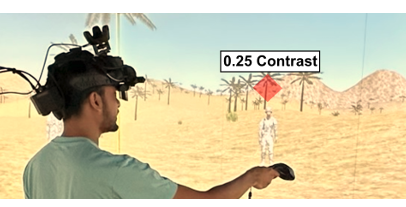
abstract = {Augmented reality (AR) display characteristics have the potential to either enhance or impair users' spatial abilities and performance. While previous work included studies of spatial performance with various display factors, evidence for objective performance differences is limited due to compensatory behaviors employed by users and overall behavioral differences. In general, it is challenging to document the effects of display factors on task performance as they depend on users' task behaviors, which in turn depend on users' reliance and trust in the technology, which are also affected by the display factors. In this paper, we present two within-subjects experiments (each N=20) in which we aim to elucidate some of the interrelations between two AR display factors (field of view and visual contrast) with objective task performance and subjective assessments of reliance and trust, while controlling for different behaviors. Participants performed a 360∘ search-and-selection task in a unique hybrid setup, in which we simulated a controlled task environment by having participants stand inside an immersive CAVE-like space while at the same time wearing a head-worn display that overlaid AR tags over the simulated environment. Specifically, we evaluated three fields of view (43∘, 93∘, and 143∘) and three visual contrasts (0.05, 0.25, and 0.5). We controlled for four different behaviors: AR-Only (only relying on AR), AR-First (prioritizing AR over real world), Real-First (prioritizing real world over AR), and Real-Only (only relying on real world). By controlling for these behaviors, we were able to show objective and subjective benefits of larger fields of view and visual contrast. We illustrate how the controlled behaviors relate to users' subjective reliance and trust in an AR system, and why it is important for researchers and practitioners to understand these subjective and behavioral aspects.},
keywords = {},
pubstate = {published},
tppubtype = {article}
}
Augmented reality (AR) display characteristics have the potential to either enhance or impair users' spatial abilities and performance. While previous work included studies of spatial performance with various display factors, evidence for objective performance differences is limited due to compensatory behaviors employed by users and overall behavioral differences. In general, it is challenging to document the effects of display factors on task performance as they depend on users' task behaviors, which in turn depend on users' reliance and trust in the technology, which are also affected by the display factors. In this paper, we present two within-subjects experiments (each N=20) in which we aim to elucidate some of the interrelations between two AR display factors (field of view and visual contrast) with objective task performance and subjective assessments of reliance and trust, while controlling for different behaviors. Participants performed a 360∘ search-and-selection task in a unique hybrid setup, in which we simulated a controlled task environment by having participants stand inside an immersive CAVE-like space while at the same time wearing a head-worn display that overlaid AR tags over the simulated environment. Specifically, we evaluated three fields of view (43∘, 93∘, and 143∘) and three visual contrasts (0.05, 0.25, and 0.5). We controlled for four different behaviors: AR-Only (only relying on AR), AR-First (prioritizing AR over real world), Real-First (prioritizing real world over AR), and Real-Only (only relying on real world). By controlling for these behaviors, we were able to show objective and subjective benefits of larger fields of view and visual contrast. We illustrate how the controlled behaviors relate to users' subjective reliance and trust in an AR system, and why it is important for researchers and practitioners to understand these subjective and behavioral aspects. |
 | Hiroshi Furuya; Matthew Gottsacker; Zubin Datta Choudhary; Austin Erickson; Ryan Schubert; Gerd Bruder; Michael P. Browne; Gregory F. Welch User Performance and Trust with Network-Connected Augmented Reality Head-Worn Displays in Unstable Network Environments Journal Article In: ACM Transactions on Applied Perception, 2026, ISSN: 1544-3558. @article{Furuya2026TrustNetworkAR,
title = {User Performance and Trust with Network-Connected Augmented Reality Head-Worn Displays in Unstable Network Environments},
author = {Hiroshi Furuya and Matthew Gottsacker and Zubin Datta Choudhary and Austin Erickson and Ryan Schubert and Gerd Bruder and Michael P. Browne and Gregory F. Welch},
url = {https://sreal.ucf.edu/wp-content/uploads/2026/07/3822592.pdf},
doi = {10.1145/3822592},
issn = {1544-3558},
year = {2026},
date = {2026-06-04},
journal = {ACM Transactions on Applied Perception},
keywords = {},
pubstate = {published},
tppubtype = {article}
}
|
 | Matt Gottsacker; Yahya Hmaiti; Mykola Maslych; Hiroshi Furuya; Jasmine Joyce DeGuzman; Gerd Bruder; Gregory F. Welch; Joseph J. LaViola Jr. From One World to Another: Interfaces for Efficiently Transitioning Between Virtual Environments Proceedings Article In: ACM CHI Conference on Human Factors in Computing Systems (CHI '26), pp. 1-17, 2026. @inproceedings{gottsacker2026worldswitch,
title = {From One World to Another: Interfaces for Efficiently Transitioning Between Virtual Environments},
author = {Matt Gottsacker and Yahya Hmaiti and Mykola Maslych and Hiroshi Furuya and Jasmine Joyce DeGuzman and Gerd Bruder and Gregory F. Welch and Joseph J. LaViola Jr.},
url = {https://sreal.ucf.edu/wp-content/uploads/2026/02/CHI2026___FullPaper__WorldSwitchUI-4.pdf},
doi = {10.1145/3772318.3791912},
year = {2026},
date = {2026-04-13},
urldate = {2026-04-13},
booktitle = {ACM CHI Conference on Human Factors in Computing Systems (CHI '26)},
pages = {1-17},
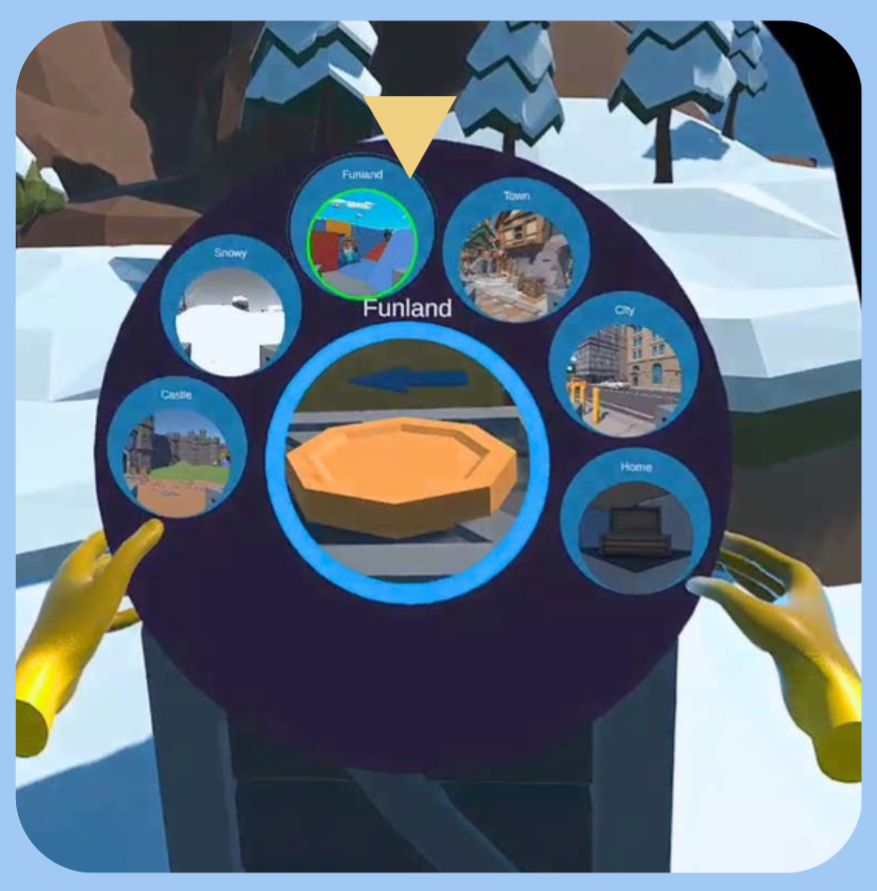
abstract = {Personal computers and handheld devices provide keyboard shortcuts and swipe gestures to enable users to efficiently switch between applications, whereas today's virtual reality (VR) systems do not. In this work, we present an exploratory study on user interface aspects to support efficient switching between worlds in VR. We created eight interfaces that afford previewing and selecting from the available virtual worlds, including methods using portals and worlds-in-miniature (WiMs). To evaluate these methods, we conducted a controlled within-subjects empirical experiment (N=22) where participants frequently transitioned between six different environments to complete an object collection task. Our quantitative and qualitative results show that WiMs supported rapid acquisition of high-level spatial information while searching and were deemed most efficient by participants while portals provided fast pre-orientation. Finally, we present insights into the applicability, usability, and effectiveness of the VR world switching methods we explored, and provide recommendations for their application and future context/world switching techniques and interfaces.},
keywords = {},
pubstate = {published},
tppubtype = {inproceedings}
}
Personal computers and handheld devices provide keyboard shortcuts and swipe gestures to enable users to efficiently switch between applications, whereas today's virtual reality (VR) systems do not. In this work, we present an exploratory study on user interface aspects to support efficient switching between worlds in VR. We created eight interfaces that afford previewing and selecting from the available virtual worlds, including methods using portals and worlds-in-miniature (WiMs). To evaluate these methods, we conducted a controlled within-subjects empirical experiment (N=22) where participants frequently transitioned between six different environments to complete an object collection task. Our quantitative and qualitative results show that WiMs supported rapid acquisition of high-level spatial information while searching and were deemed most efficient by participants while portals provided fast pre-orientation. Finally, we present insights into the applicability, usability, and effectiveness of the VR world switching methods we explored, and provide recommendations for their application and future context/world switching techniques and interfaces. |
 | Hiroshi Furuya; Jasmine Joyce DeGuzman; Zubin Datta Choudhary; Matt Gottsacker; Ahinya Alwin; Lee Lisle; Gerd Bruder; Gregory F Welch Effects of Multisensory Feedback and Real-World Priming on Presence and Copresence in Mixed Reality Drone Simulation Proceedings Article In: Proceedings of the 2026 IEEE Conference on Virtual Reality and 3D User Interfaces Abstracts and Workshops (IEEE VRW): 2nd Annual Workshop on Real and Virtual Spaces Influences (ReVISI), pp. 1-7, 2026. @inproceedings{furuya-real-world-priming-26,
title = {Effects of Multisensory Feedback and Real-World Priming on Presence and Copresence in Mixed Reality Drone Simulation},
author = {Hiroshi Furuya and Jasmine Joyce DeGuzman and Zubin Datta Choudhary and Matt Gottsacker and Ahinya Alwin and Lee Lisle and Gerd Bruder and Gregory F Welch},
url = {https://sreal.ucf.edu/wp-content/uploads/2026/02/VR26_Revisi__Real_World_Priming_for_VR_Experiences-3.pdf},
year = {2026},
date = {2026-03-21},
urldate = {2026-03-21},
booktitle = {Proceedings of the 2026 IEEE Conference on Virtual Reality and 3D User Interfaces Abstracts and Workshops (IEEE VRW): 2nd Annual Workshop on Real and Virtual Spaces Influences (ReVISI)},
pages = {1-7},
abstract = {Virtual reality (VR) experiences often rely on multisensory cues and realistic interactions to support convincing interpretations of virtual events and agents. This study examines how two factors, real-world priming and multisensory feedback, shape users’ perceptions of a virtual drone in a mixed-reality simulation. We conducted a mixed-design experiment where participants experienced either a physical drone flyover or no physical drone encounter, followed by audiovisual and multisensory drone flyovers in VR. Multisensory feedback increased co-presence and perceived realism specifically for participants who had encountered the real drone. In contrast, neither manipulation significantly affected standard presence measures. These findings highlight distinctions among presence-related constructs and suggest that recent real-world experiences can make certain multisensory cues be perceived as more realistic, even when they do not increase presence itself.},
keywords = {},
pubstate = {published},
tppubtype = {inproceedings}
}
Virtual reality (VR) experiences often rely on multisensory cues and realistic interactions to support convincing interpretations of virtual events and agents. This study examines how two factors, real-world priming and multisensory feedback, shape users’ perceptions of a virtual drone in a mixed-reality simulation. We conducted a mixed-design experiment where participants experienced either a physical drone flyover or no physical drone encounter, followed by audiovisual and multisensory drone flyovers in VR. Multisensory feedback increased co-presence and perceived realism specifically for participants who had encountered the real drone. In contrast, neither manipulation significantly affected standard presence measures. These findings highlight distinctions among presence-related constructs and suggest that recent real-world experiences can make certain multisensory cues be perceived as more realistic, even when they do not increase presence itself. |
![[Poster] Can You See It? Evaluating Color Visibility in Simulated Outdoor Environments](https://sreal.ucf.edu/wp-content/uploads/2026/02/teaser_AA-150x150.png) | Ahinya Alwin; Matthew Gottsacker; Hiroshi Furuya; Armin Delmo; Lee Lisle; Gerd Bruder; Gregory F. Welch [Poster] Can You See It? Evaluating Color Visibility in Simulated Outdoor Environments Proceedings Article In: Proceedings of IEEE Conference on Virtual Reality and 3D User Interfaces (IEEE VR) 2026., 2026. @inproceedings{Alwin2026_2,
title = {[Poster] Can You See It? Evaluating Color Visibility in Simulated Outdoor Environments},
author = {Ahinya Alwin and Matthew Gottsacker and Hiroshi Furuya and Armin Delmo and Lee Lisle and Gerd Bruder and Gregory F. Welch},
url = {https://sreal.ucf.edu/wp-content/uploads/2026/02/vr26b-sub1299-cam-i5.pdf},
year = {2026},
date = {2026-03-21},
urldate = {2026-03-21},
booktitle = {Proceedings of IEEE Conference on Virtual Reality and 3D User Interfaces (IEEE VR) 2026.},
journal = {Proceedings of IEEE Conference on Virtual Reality and 3D User Interfaces (IEEE VR) 2026, Daegu, South Korea.},
abstract = {Evaluating color visibility in outdoor augmented reality (AR) is challenging due to the visual complexity and variability of real world environments. Outdoor scenes feature diverse textures and lighting conditions, limiting the applicability of visibility evaluation methods developed for simple or static backgrounds. This work introduces a methodology for evaluating AR cue color visibility in an outdoor environment by sampling visibility across realistic scenes and identifying design considerations for evaluating color visibility under dynamic, visually complex conditions},
keywords = {},
pubstate = {published},
tppubtype = {inproceedings}
}
Evaluating color visibility in outdoor augmented reality (AR) is challenging due to the visual complexity and variability of real world environments. Outdoor scenes feature diverse textures and lighting conditions, limiting the applicability of visibility evaluation methods developed for simple or static backgrounds. This work introduces a methodology for evaluating AR cue color visibility in an outdoor environment by sampling visibility across realistic scenes and identifying design considerations for evaluating color visibility under dynamic, visually complex conditions |
 | Ahinya Alwin; Matthew Gottsacker; Hiroshi Furuya; Lee Lisle; Gerd Bruder; Gregory F. Welch Moving Towards Visibility Evaluation in Augmented Reality Using Simulated Environments and Continuous Psychophysics Proceedings Article In: Proceedings of the 2026 IEEE Conference on Virtual Reality and 3D User Interfaces Abstracts and Workshops (IEEE VRW): Third International Workshop on Perception-driven Graphics and Displays for VR and AR (PerGraVAR), 2026. @inproceedings{Alwin2026b,
title = {Moving Towards Visibility Evaluation in Augmented Reality Using Simulated Environments and Continuous Psychophysics},
author = {Ahinya Alwin and Matthew Gottsacker and Hiroshi Furuya and Lee Lisle and Gerd Bruder and Gregory F. Welch},
url = {https://sreal.ucf.edu/ieee_vr_2026_workshops_pergravar__visibility_evaluation_in_augmented_reality_using_simulated_environments_and_continuous_psychophysics_013026/},
year = {2026},
date = {2026-03-21},
urldate = {2026-03-21},
booktitle = {Proceedings of the 2026 IEEE Conference on Virtual Reality and 3D User Interfaces Abstracts and Workshops (IEEE VRW): Third International Workshop on Perception-driven Graphics and Displays for VR and AR (PerGraVAR)},
abstract = {Assessing the visibility of augmented reality (AR) cues in outdoor environments is challenging due to complex background structure, motion, and lighting variability. Simulating AR cues within virtual reality (VR) enables controlled manipulation and measurement of these factors while preserving immersive viewing conditions. This work presents a perception-driven methodology for evaluating AR cue visibility that combines simulated AR cues in VR, high resolution stereoscopic 360◦ video, and continuous psychophysics. Using this methodology, tracking-based performance data provide a continuous behavioral measure of visibility in complex scenes. Multiple analysis approaches are examined to support interpretation of tracking-based measures of perceptual performance in visually complex scenes. Together, this work illustrates progress toward a more ecologically valid and objective framework for studying AR cue visibility in outdoor settings.},
keywords = {},
pubstate = {published},
tppubtype = {inproceedings}
}
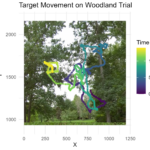
Assessing the visibility of augmented reality (AR) cues in outdoor environments is challenging due to complex background structure, motion, and lighting variability. Simulating AR cues within virtual reality (VR) enables controlled manipulation and measurement of these factors while preserving immersive viewing conditions. This work presents a perception-driven methodology for evaluating AR cue visibility that combines simulated AR cues in VR, high resolution stereoscopic 360◦ video, and continuous psychophysics. Using this methodology, tracking-based performance data provide a continuous behavioral measure of visibility in complex scenes. Multiple analysis approaches are examined to support interpretation of tracking-based measures of perceptual performance in visually complex scenes. Together, this work illustrates progress toward a more ecologically valid and objective framework for studying AR cue visibility in outdoor settings. |
2025
|
 | Matt Gottsacker; Yahya Hmaiti; Mykola Maslych; Hiroshi Furuya; Gerd Bruder; Gregory F Welch; Joseph J. LaViola Jr. XR-First Design for Productivity: A Conceptual Framework for Enabling Efficient Task Switching in XR Proceedings Article In: IEEE International Symposium on Mixed and Augmented Reality (ISMAR) Adjunct Proceedings, 2025. @inproceedings{nokey,
title = {XR-First Design for Productivity: A Conceptual Framework for Enabling Efficient Task Switching in XR},
author = {Matt Gottsacker and Yahya Hmaiti and Mykola Maslych and Hiroshi Furuya and Gerd Bruder and Gregory F Welch and Joseph J. LaViola Jr.},
url = {https://sreal.ucf.edu/wp-content/uploads/2025/09/ISMAR25__Workshop_Paper__xrWORKS__VR_World_Switch_UI-11.pdf},
year = {2025},
date = {2025-10-08},
urldate = {2025-10-08},
booktitle = {IEEE International Symposium on Mixed and Augmented Reality (ISMAR) Adjunct Proceedings},
abstract = {A core component of completing tasks efficiently in computer supported knowledge work is the ability for users to rapidly switch their focus (and interaction) across different applications using various shortcuts and gestures. This feature set has been explored in research, and several modern consumer extended reality (XR) headsets now support loading multiple applications windows at once. However, many XR applications that are useful for knowledge work involve rich spatial information, which window-based metaphors do not sufficiently represent nor afford appropriate interaction. In modern XR headsets, such immersive applications run as siloed experiences, requiring the user to fully exit one before starting another. We present a vision for achieving an XR-first, user-centric paradigm for efficient context switching in XR to encourage and guide future research and development of XR context- and task-switching interfaces.},
keywords = {},
pubstate = {published},
tppubtype = {inproceedings}
}
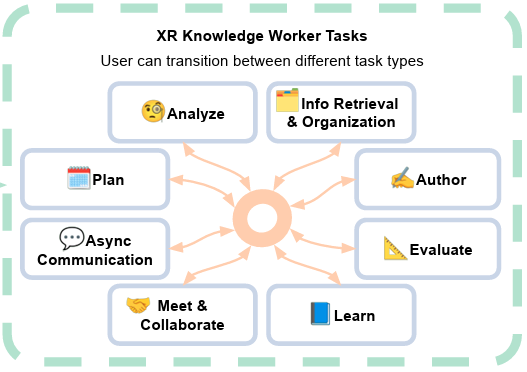
A core component of completing tasks efficiently in computer supported knowledge work is the ability for users to rapidly switch their focus (and interaction) across different applications using various shortcuts and gestures. This feature set has been explored in research, and several modern consumer extended reality (XR) headsets now support loading multiple applications windows at once. However, many XR applications that are useful for knowledge work involve rich spatial information, which window-based metaphors do not sufficiently represent nor afford appropriate interaction. In modern XR headsets, such immersive applications run as siloed experiences, requiring the user to fully exit one before starting another. We present a vision for achieving an XR-first, user-centric paradigm for efficient context switching in XR to encourage and guide future research and development of XR context- and task-switching interfaces. |
 | Matt Gottsacker; Yahya Hmaiti; Mykola Maslych; Hiroshi Furuya; Gerd Bruder; Gregory F Welch; Joseph J. LaViola Jr. From Alt-Tab to World-Snap: Exploring Different Metaphors for Swift and Seamless VR World Switching Proceedings Article In: IEEE International Symposium on Mixed and Augmented Reality, pp. 1-2, 2025. @inproceedings{nokey,
title = {From Alt-Tab to World-Snap: Exploring Different Metaphors for Swift and Seamless VR World Switching},
author = {Matt Gottsacker and Yahya Hmaiti and Mykola Maslych and Hiroshi Furuya and Gerd Bruder and Gregory F Welch and Joseph J. LaViola Jr.},
url = {https://sreal.ucf.edu/wp-content/uploads/2025/09/ISMAR25__Demo__VR_World_Switch_UI.pdf},
year = {2025},
date = {2025-10-08},
urldate = {2025-10-08},
booktitle = {IEEE International Symposium on Mixed and Augmented Reality},
pages = {1-2},
abstract = {Today's personal computers and handheld devices afford users the ability to rapidly switch between different applications, e.g., using keyboard shortcuts and swipe gestures. In today's virtual reality (VR) systems, immersive applications are siloed experiences that users must fully exit before starting another. We demonstrate eight prototypes of world switching interfaces that let users preview, select, and transition across multiple virtual environments in a continuous interaction, mirroring the ``Alt+Tab" agility of desktop multitasking. We developed these techniques based on portals and worlds-in-miniature (WiM) metaphors that reveal the destination environment before triggering a full transition. },
keywords = {},
pubstate = {published},
tppubtype = {inproceedings}
}
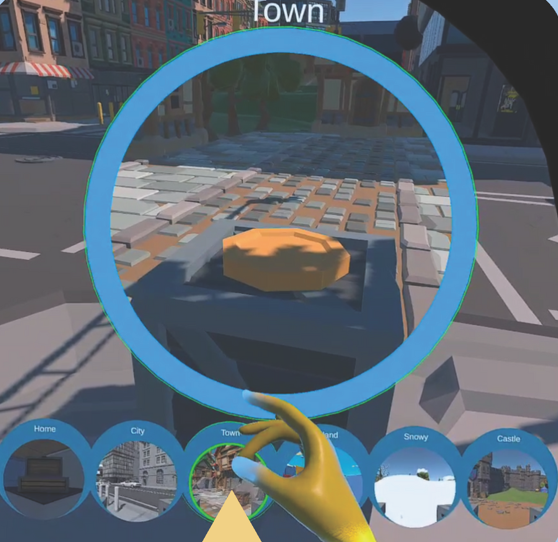
Today's personal computers and handheld devices afford users the ability to rapidly switch between different applications, e.g., using keyboard shortcuts and swipe gestures. In today's virtual reality (VR) systems, immersive applications are siloed experiences that users must fully exit before starting another. We demonstrate eight prototypes of world switching interfaces that let users preview, select, and transition across multiple virtual environments in a continuous interaction, mirroring the ``Alt+Tab" agility of desktop multitasking. We developed these techniques based on portals and worlds-in-miniature (WiM) metaphors that reveal the destination environment before triggering a full transition. |
 | Hiroshi Furuya; Jasmine Joyce DeGuzman; Zubin Datta Choudhary; Matthew Gottsacker; Gerd Bruder; Gregory F. Welch How Does Presence Affect Trust in Simulated Autonomous Agents? Proceedings Article In: Proceedings of the 2025 IEEE Conference on Virtual Reality and 3D User Interfaces Abstracts and Workshops (IEEE VRW): 1st Annual Workshop on Real and Virtual Spaces Influences (ReVISI), pp. 1-2, 2025. @inproceedings{Furuya2025hc,
title = {How Does Presence Affect Trust in Simulated Autonomous Agents?},
author = {Hiroshi Furuya and Jasmine Joyce DeGuzman and Zubin Datta Choudhary and Matthew Gottsacker and Gerd Bruder and Gregory F. Welch},
url = {https://sreal.ucf.edu/wp-content/uploads/2025/10/How_Does_Presence_Affect_Trust_in_Simulated_Autonomous_Agents.pdf},
doi = {10.1109/VRW66409.2025.00109},
year = {2025},
date = {2025-03-08},
urldate = {2025-03-08},
booktitle = {Proceedings of the 2025 IEEE Conference on Virtual Reality and 3D User Interfaces Abstracts and Workshops (IEEE VRW): 1st Annual Workshop on Real and Virtual Spaces Influences (ReVISI)},
pages = {1-2},
abstract = {Autonomous agents present important novel capabilities for a wide swath of applications like simulating interactions between humans and agents. Simulating these interactions in VR has become an important tool for evaluating the effects of agents on human behavior and performance, including human-agent trust. This position paper presents research opportunities in the use of real-world multi-modal feedback and real-world priming experiences may have on the validity of trust measurements taken from simulated human-agent interactions in VR. In addition, it presents a hypothetical experiment addressing research questions related to this topic.},
keywords = {},
pubstate = {published},
tppubtype = {inproceedings}
}
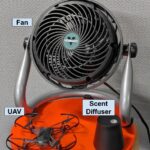
Autonomous agents present important novel capabilities for a wide swath of applications like simulating interactions between humans and agents. Simulating these interactions in VR has become an important tool for evaluating the effects of agents on human behavior and performance, including human-agent trust. This position paper presents research opportunities in the use of real-world multi-modal feedback and real-world priming experiences may have on the validity of trust measurements taken from simulated human-agent interactions in VR. In addition, it presents a hypothetical experiment addressing research questions related to this topic. |
2024
|
 | Zubin Choudhary; Laura Battistel; Raiffa Syamil; Hiroshi Furuya; Ferran Argelaguet; Gerd Bruder; Gregory F. Welch Examining the Effects of Teleportation on Semantic Memory of a Virtual Museum Compared to Natural Walking Proceedings Article In: Proceedings of the International Conference on Artificial Reality and Telexistence and Eurographics Symposium on Virtual Environments (ICAT-EGVE 2024), Tsukuba, Japan, December 1-3, 2024, pp. 1-12, 2024. @inproceedings{Choudhary2024walking,
title = {Examining the Effects of Teleportation on Semantic Memory of a Virtual Museum Compared to Natural Walking},
author = {Zubin Choudhary and Laura Battistel and Raiffa Syamil and Hiroshi Furuya and Ferran Argelaguet and Gerd Bruder and Gregory F. Welch},
url = {https://sreal.ucf.edu/wp-content/uploads/2024/10/paper1028_2.pdf},
year = {2024},
date = {2024-12-01},
urldate = {2024-12-01},
booktitle = {Proceedings of the International Conference on Artificial Reality and Telexistence and Eurographics Symposium on Virtual Environments (ICAT-EGVE 2024), Tsukuba, Japan, December 1-3, 2024},
pages = {1-12},
abstract = {Over the past decades there has been extensive research investigating the trade-offs between various Virtual Reality (VR) locomotion techniques. One of the most highly researched techniques is teleportation, due to its ability to quickly traverse large virtual spaces even in limited physical tracking spaces. The majority of teleportation research has been focused on its effects on spatial cognition, such as spatial understanding and retention. However, relatively little is known about whether the use of teleportation in immersive learning experiences can effect the acquisition of semantic knowledge — our knowledge about facts, concepts, and ideas — which is essential for long-term learning. In this paper we present a human-subjects study to investigate the effects of teleportation compared to natural walking on the retention of semantic information about artifacts in a virtual museum. Participants visited unique 3D artifacts accompanied by audio clips and artifact names. Our results show that participants reached the same semantic memory performance with both locomotion techniques but with different behaviors, self-assessed performance, and preference. In particular, participants subjectively indicated that they felt that they recalled more semantic memory with walking than teleportation. However, objectively, they spent more time with the artifacts while walking, meaning that they learnt less per a set amount of time than with teleportation. We discuss the relationships, implications, and guidelines for VR experiences designed to help users acquire new knowledge.},
keywords = {},
pubstate = {published},
tppubtype = {inproceedings}
}
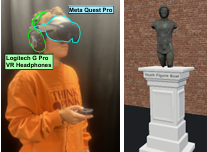
Over the past decades there has been extensive research investigating the trade-offs between various Virtual Reality (VR) locomotion techniques. One of the most highly researched techniques is teleportation, due to its ability to quickly traverse large virtual spaces even in limited physical tracking spaces. The majority of teleportation research has been focused on its effects on spatial cognition, such as spatial understanding and retention. However, relatively little is known about whether the use of teleportation in immersive learning experiences can effect the acquisition of semantic knowledge — our knowledge about facts, concepts, and ideas — which is essential for long-term learning. In this paper we present a human-subjects study to investigate the effects of teleportation compared to natural walking on the retention of semantic information about artifacts in a virtual museum. Participants visited unique 3D artifacts accompanied by audio clips and artifact names. Our results show that participants reached the same semantic memory performance with both locomotion techniques but with different behaviors, self-assessed performance, and preference. In particular, participants subjectively indicated that they felt that they recalled more semantic memory with walking than teleportation. However, objectively, they spent more time with the artifacts while walking, meaning that they learnt less per a set amount of time than with teleportation. We discuss the relationships, implications, and guidelines for VR experiences designed to help users acquire new knowledge. |
 | Hiroshi Furuya; Zubin Choudhary; Jasmine Joyce DeGuzman; Matt Gottsacker; Gerd Bruder; Greg Welch Using Simulated Real-world Terrain in VR to Study Outdoor AR Topographic Map Interfaces Proceedings Article In: Proceedings of the International Conference on Artificial Reality and Telexistence and Eurographics Symposium on Virtual Environments (ICAT-EGVE 2024), Tsukuba, Japan, December 1-3, 2024, pp. 1-10, 2024. @inproceedings{Furuya2024topo,
title = {Using Simulated Real-world Terrain in VR to Study Outdoor AR Topographic Map Interfaces},
author = {Hiroshi Furuya and Zubin Choudhary and Jasmine Joyce DeGuzman and Matt Gottsacker and Gerd Bruder and Greg Welch},
url = {https://sreal.ucf.edu/wp-content/uploads/2024/10/cameraready_ICAT_EGVE_2024_1029_topographic_map.pdf},
doi = {tbd},
year = {2024},
date = {2024-12-01},
urldate = {2024-12-01},
booktitle = {Proceedings of the International Conference on Artificial Reality and Telexistence and Eurographics Symposium on Virtual Environments (ICAT-EGVE 2024), Tsukuba, Japan, December 1-3, 2024},
pages = {1-10},
abstract = {Augmented reality (AR) technology enables advanced integration of spatial information useful in a variety of important domains, including for reading topographic maps in the field. It is also important to understand how this technology may potentially affect spatial learning ability. In this paper, we demonstrate the use of virtual reality (VR) to conduct a human-subject study investigating the impacts of different simulated AR topographic map interface designs on spatial learning outcomes. Our results show that interfaces that encourage engagement with the interface instead of with the map and the environment result in fast task completion times but poor spatial learning. We also found participant preference for a novel interface design that assists users with map orientation without explicitly guiding the user through the task.},
keywords = {},
pubstate = {published},
tppubtype = {inproceedings}
}
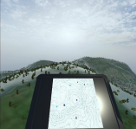
Augmented reality (AR) technology enables advanced integration of spatial information useful in a variety of important domains, including for reading topographic maps in the field. It is also important to understand how this technology may potentially affect spatial learning ability. In this paper, we demonstrate the use of virtual reality (VR) to conduct a human-subject study investigating the impacts of different simulated AR topographic map interface designs on spatial learning outcomes. Our results show that interfaces that encourage engagement with the interface instead of with the map and the environment result in fast task completion times but poor spatial learning. We also found participant preference for a novel interface design that assists users with map orientation without explicitly guiding the user through the task. |
 | Matt Gottsacker; Hiroshi Furuya; Laura Battistel; Carlos Pinto Jimenez; Nicholas LaMontagna; Gerd Bruder; and Gregory F. Welch Exploring Spatial Cognitive Residue and Methods to Clear Users’ Minds When Transitioning Between Virtual Environments Proceedings Article In: IEEE International Symposium of Mixed and Augmented Reality (ISMAR), pp. 1-11, 2024. @inproceedings{nokey,
title = {Exploring Spatial Cognitive Residue and Methods to Clear Users’ Minds When Transitioning Between Virtual Environments},
author = {Matt Gottsacker and Hiroshi Furuya and Laura Battistel and Carlos Pinto Jimenez and Nicholas LaMontagna and Gerd Bruder and and Gregory F. Welch},
url = {https://sreal.ucf.edu/wp-content/uploads/2024/08/ISMAR24____Conference____Residue-5.pdf},
year = {2024},
date = {2024-10-21},
urldate = {2024-10-21},
booktitle = {IEEE International Symposium of Mixed and Augmented Reality (ISMAR)},
pages = {1-11},
abstract = {In most cases, retaining memories of things we have experienced in the past is desirable, but in some cases, we want to clear our minds so that we may focus completely on subsequent activities. When someone switches from one task to another, they commonly incur some “cognitive residue” where some of their cognitive resources such as working memory and attention remain devoted to their previous task even after they try to switch their focus to their new task. This residue could have a negative impact on their performance in the next task, and in such circumstances, it is important to reduce that residue. In this paper, we explore the concept of cognitive residue in the context of switching between virtual reality (VR) environments. We conducted a human-subject experiment (N=24) with a spatial recall task to investigate how different visual transitions might reduce participants’ spatial cognitive residue. In this instance, more errors on the recall task corresponds to less spatial cognitive residue. We found that transitions that lasted one minute successfully reduced spatial cognitive residue: they significantly reduced participants’ abilities to recall the positions of objects in their previous VE compared to an instantaneous cut transition. Additionally, for transitions that showed a nature scene, greater head movement significantly correlated with more spatial memory errors (i.e., less spatial cognitive residue). We discuss how these findings can be applied to support users transitioning between virtual tasks and environments in VR task switching scenarios.},
keywords = {},
pubstate = {published},
tppubtype = {inproceedings}
}
In most cases, retaining memories of things we have experienced in the past is desirable, but in some cases, we want to clear our minds so that we may focus completely on subsequent activities. When someone switches from one task to another, they commonly incur some “cognitive residue” where some of their cognitive resources such as working memory and attention remain devoted to their previous task even after they try to switch their focus to their new task. This residue could have a negative impact on their performance in the next task, and in such circumstances, it is important to reduce that residue. In this paper, we explore the concept of cognitive residue in the context of switching between virtual reality (VR) environments. We conducted a human-subject experiment (N=24) with a spatial recall task to investigate how different visual transitions might reduce participants’ spatial cognitive residue. In this instance, more errors on the recall task corresponds to less spatial cognitive residue. We found that transitions that lasted one minute successfully reduced spatial cognitive residue: they significantly reduced participants’ abilities to recall the positions of objects in their previous VE compared to an instantaneous cut transition. Additionally, for transitions that showed a nature scene, greater head movement significantly correlated with more spatial memory errors (i.e., less spatial cognitive residue). We discuss how these findings can be applied to support users transitioning between virtual tasks and environments in VR task switching scenarios. |
 | Hiroshi Furuya; Laura Battistel; Zubin Datta Choudhary; Matt Gottsacker; Gerd Bruder; Gregory F Welch Difficulties in Perceiving and Understanding Robot Reliability Changes in a Sequential Binary Task Proceedings Article In: Proceedings of the 2024 ACM Symposium on Spatial User Interaction, pp. 1-11, Association for Computing Machinery, Trier, Germany, 2024, ISBN: 9798400710889. @inproceedings{Furuya2024perceive,
title = {Difficulties in Perceiving and Understanding Robot Reliability Changes in a Sequential Binary Task},
author = {Hiroshi Furuya and Laura Battistel and Zubin Datta Choudhary and Matt Gottsacker and Gerd Bruder and Gregory F Welch},
url = {https://sreal.ucf.edu/wp-content/uploads/2024/08/SUI_2024___Difficulties_in_Perceiving_and_Understanding_Robot_Reliability_Changes_in_a_Sequential_Binary_Task-1-2.pdf},
doi = {10.1145/3677386.3682083},
isbn = {9798400710889},
year = {2024},
date = {2024-10-07},
urldate = {2024-10-07},
booktitle = {Proceedings of the 2024 ACM Symposium on Spatial User Interaction},
pages = {1-11},
publisher = {Association for Computing Machinery},
address = {Trier, Germany},
series = {SUI '24},
abstract = {Human-robot teams push the boundaries of what both humans and robots can accomplish. In order for the team to function well, the human must accurately assess the robot’s capabilities to calibrate the trust between the human and robot. In this paper, we use virtual reality (VR), a widely accepted tool in studying human-robot interaction (HRI), to study human behaviors affecting their detection and understanding of changes in a simulated robot’s reliability. We present a human-subject study to see how different reliability change factors may affect this process. Our results demonstrate that participants make judgements about robot reliability before they have accumulated sufficient evidence to make objectively high-confidence inferences about robot reliability. We show that this reliability change observation behavior diverges from behavior expectations based on the probability distribution functions used to describe observation outcomes.},
keywords = {},
pubstate = {published},
tppubtype = {inproceedings}
}
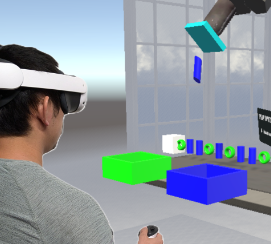
Human-robot teams push the boundaries of what both humans and robots can accomplish. In order for the team to function well, the human must accurately assess the robot’s capabilities to calibrate the trust between the human and robot. In this paper, we use virtual reality (VR), a widely accepted tool in studying human-robot interaction (HRI), to study human behaviors affecting their detection and understanding of changes in a simulated robot’s reliability. We present a human-subject study to see how different reliability change factors may affect this process. Our results demonstrate that participants make judgements about robot reliability before they have accumulated sufficient evidence to make objectively high-confidence inferences about robot reliability. We show that this reliability change observation behavior diverges from behavior expectations based on the probability distribution functions used to describe observation outcomes. |
 | Matt Gottsacker; Hiroshi Furuya; Zubin Choudhary; Austin Erickson; Ryan Schubert; Gerd Bruder; Michael P. Browne; Gregory F. Welch Investigating the relationships between user behaviors and tracking factors on task performance and trust in augmented reality Journal Article In: Elsevier Computers & Graphics, vol. 123, pp. 1-14, 2024. @article{gottsacker2024trust,
title = {Investigating the relationships between user behaviors and tracking factors on task performance and trust in augmented reality},
author = {Matt Gottsacker and Hiroshi Furuya and Zubin Choudhary and Austin Erickson and Ryan Schubert and Gerd Bruder and Michael P. Browne and Gregory F. Welch},
url = {https://sreal.ucf.edu/wp-content/uploads/2024/08/C_G____ARTrust____Accuracy___Precision.pdf},
doi = {https://doi.org/10.1016/j.cag.2024.104035},
year = {2024},
date = {2024-08-06},
urldate = {2024-08-06},
journal = {Elsevier Computers & Graphics},
volume = {123},
pages = {1-14},
abstract = {This research paper explores the impact of augmented reality (AR) tracking characteristics, specifically an AR head-worn display's tracking registration accuracy and precision, on users' spatial abilities and subjective perceptions of trust in and reliance on the technology. Our study aims to clarify the relationships between user performance and the different behaviors users may employ based on varying degrees of trust in and reliance on AR. Our controlled experimental setup used a 360 field-of-regard search-and-selection task and combines the immersive aspects of a CAVE-like environment with AR overlays viewed with a head-worn display. We investigated three levels of simulated AR tracking errors in terms of both accuracy and precision (+0, +1, +2). We controlled for four user task behaviors that correspond to different levels of trust in and reliance on an AR system: AR-Only (only relying on AR), AR-First (prioritizing AR over real world), Real-Only (only relying on real world), and Real-First (prioritizing real world over AR). By controlling for these behaviors, our results showed that even small amounts of AR tracking errors had noticeable effects on users' task performance, especially if they relied completely on the AR cues (AR-Only). Our results link AR tracking characteristics with user behavior, highlighting the importance of understanding these elements to improve AR technology and user satisfaction.},
keywords = {},
pubstate = {published},
tppubtype = {article}
}
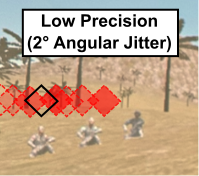
This research paper explores the impact of augmented reality (AR) tracking characteristics, specifically an AR head-worn display's tracking registration accuracy and precision, on users' spatial abilities and subjective perceptions of trust in and reliance on the technology. Our study aims to clarify the relationships between user performance and the different behaviors users may employ based on varying degrees of trust in and reliance on AR. Our controlled experimental setup used a 360 field-of-regard search-and-selection task and combines the immersive aspects of a CAVE-like environment with AR overlays viewed with a head-worn display. We investigated three levels of simulated AR tracking errors in terms of both accuracy and precision (+0, +1, +2). We controlled for four user task behaviors that correspond to different levels of trust in and reliance on an AR system: AR-Only (only relying on AR), AR-First (prioritizing AR over real world), Real-Only (only relying on real world), and Real-First (prioritizing real world over AR). By controlling for these behaviors, our results showed that even small amounts of AR tracking errors had noticeable effects on users' task performance, especially if they relied completely on the AR cues (AR-Only). Our results link AR tracking characteristics with user behavior, highlighting the importance of understanding these elements to improve AR technology and user satisfaction. |
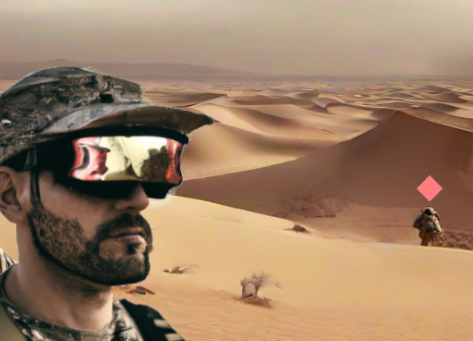 | Gerd Bruder; Michael Browne; Zubin Choudhary; Austin Erickson; Hiroshi Furuya; Matt Gottsacker; Ryan Schubert; Gregory Welch Visual Factors Influencing Trust and Reliance with Augmented Reality Systems Journal Article In: Journal of Vision Abstracts—Vision Sciences Society (VSS) Annual Meeting, 2024. @article{Bruder2024,
title = {Visual Factors Influencing Trust and Reliance with Augmented Reality Systems},
author = {Gerd Bruder and Michael Browne and Zubin Choudhary and Austin Erickson and Hiroshi Furuya and Matt Gottsacker and Ryan Schubert and Gregory Welch},
year = {2024},
date = {2024-05-17},
urldate = {2024-05-17},
journal = {Journal of Vision Abstracts—Vision Sciences Society (VSS) Annual Meeting},
abstract = {Augmented Reality (AR) systems are increasingly used for simulations, training, and operations across a wide range of application fields. Unfortunately, the imagery that current AR systems create often does not match our visual perception of the real world, which can make users feel like the AR system is not believable. This lack of belief can lead to negative training or experiences, where users lose trust in the AR system and adjust their reliance on AR. The latter is characterized by users adopting different cognitive perception-action pathways by which they integrate AR visual information for spatial tasks. In this work, we present a series of six within-subjects experiments (each N=20) in which we investigated trust in AR with respect to two display factors (field of view and visual contrast), two tracking factors (accuracy and precision), and two network factors (latency and dropouts). Participants performed a 360-degree visual search-and-selection task in a hybrid setup involving an AR head-mounted display and a CAVE-like simulated real environment. Participants completed the experiments with four perception-action pathways that represent different levels of the users’ reliance on an AR system: AR-Only (only relying on AR), AR-First (prioritizing AR over real world), Real-First (prioritizing real world over AR), and Real-Only (only relying on real world). Our results show that participants’ perception-action pathways and objective task performance were significantly affected by all six tested AR factors. In contrast, we found that their subjective responses for trust and reliance were often more affected by slight AR system differences than would elicit objective performance differences, and participants tended to overestimate or underestimate the trustworthiness of the AR system. Participants showed significantly higher task performance gains if their sense of trust was well-calibrated to the trustworthiness of the AR system, highlighting the importance of effectively managing users’ trust in future AR systems.
Acknowledgements: This material includes work supported in part by Vision Products LLC via US Air Force Research Laboratory (AFRL) Award Number FA864922P1038, and the Office of Naval Research under Award Numbers N00014-21-1-2578 and N00014-21-1-2882 (Dr. Peter Squire, Code 34).},
keywords = {},
pubstate = {published},
tppubtype = {article}
}
Augmented Reality (AR) systems are increasingly used for simulations, training, and operations across a wide range of application fields. Unfortunately, the imagery that current AR systems create often does not match our visual perception of the real world, which can make users feel like the AR system is not believable. This lack of belief can lead to negative training or experiences, where users lose trust in the AR system and adjust their reliance on AR. The latter is characterized by users adopting different cognitive perception-action pathways by which they integrate AR visual information for spatial tasks. In this work, we present a series of six within-subjects experiments (each N=20) in which we investigated trust in AR with respect to two display factors (field of view and visual contrast), two tracking factors (accuracy and precision), and two network factors (latency and dropouts). Participants performed a 360-degree visual search-and-selection task in a hybrid setup involving an AR head-mounted display and a CAVE-like simulated real environment. Participants completed the experiments with four perception-action pathways that represent different levels of the users’ reliance on an AR system: AR-Only (only relying on AR), AR-First (prioritizing AR over real world), Real-First (prioritizing real world over AR), and Real-Only (only relying on real world). Our results show that participants’ perception-action pathways and objective task performance were significantly affected by all six tested AR factors. In contrast, we found that their subjective responses for trust and reliance were often more affected by slight AR system differences than would elicit objective performance differences, and participants tended to overestimate or underestimate the trustworthiness of the AR system. Participants showed significantly higher task performance gains if their sense of trust was well-calibrated to the trustworthiness of the AR system, highlighting the importance of effectively managing users’ trust in future AR systems.
Acknowledgements: This material includes work supported in part by Vision Products LLC via US Air Force Research Laboratory (AFRL) Award Number FA864922P1038, and the Office of Naval Research under Award Numbers N00014-21-1-2578 and N00014-21-1-2882 (Dr. Peter Squire, Code 34). |
2022
|
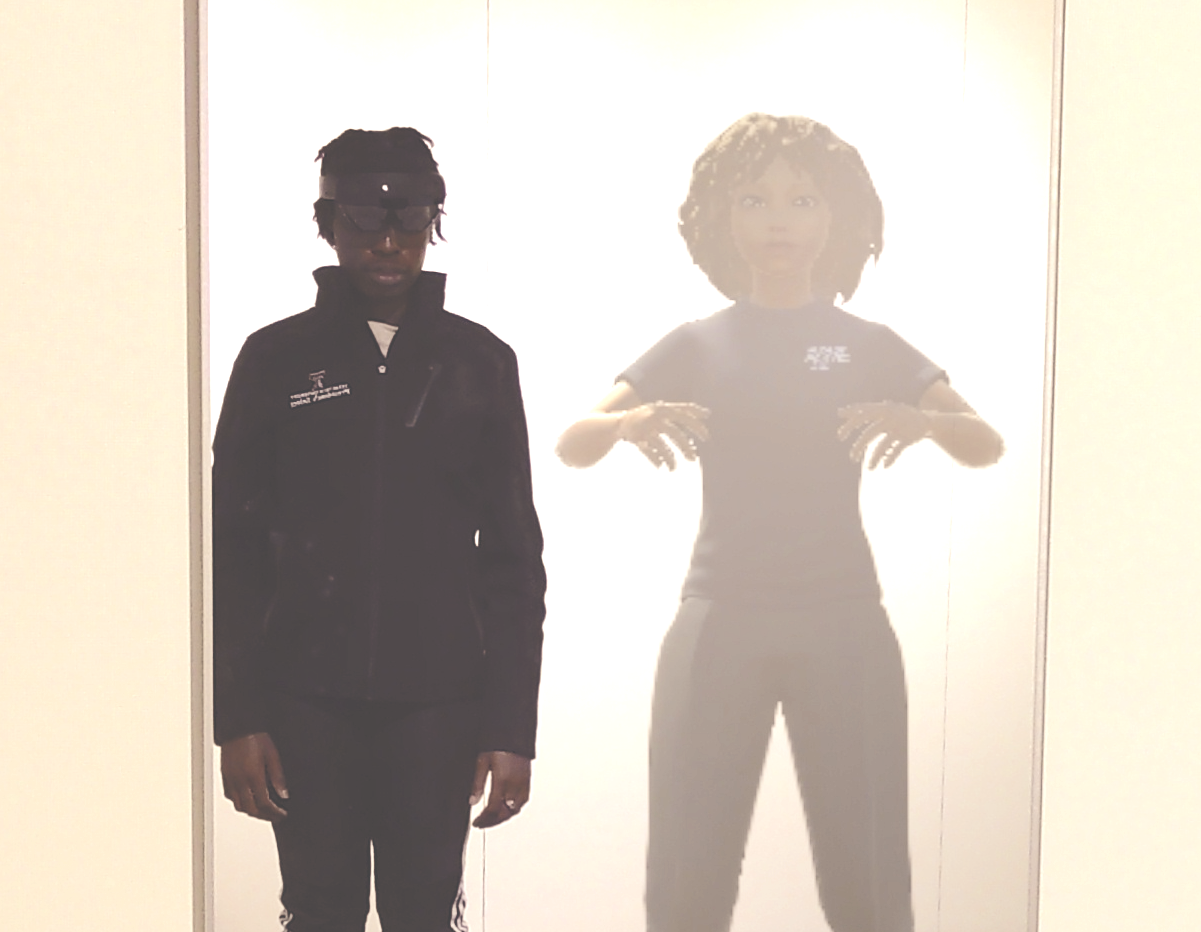 | Meelad Doroodchi; Priscilla Ramos; Austin Erickson; Hiroshi Furuya; Juanita Benjamin; Gerd Bruder; Gregory F. Welch Effects of Optical See-Through Displays on Self-Avatar Appearance in Augmented Reality Proceedings Article In: Proceedings of the International Symposium on Mixed and Augmented Reality (ISMAR), IEEE 2022. @inproceedings{Ramos2022,
title = {Effects of Optical See-Through Displays on Self-Avatar Appearance in Augmented Reality},
author = {Meelad Doroodchi and Priscilla Ramos and Austin Erickson and Hiroshi Furuya and Juanita Benjamin and Gerd Bruder and Gregory F. Welch},
url = {https://sreal.ucf.edu/wp-content/uploads/2022/10/IDEATExR2022_REU_Paper.pdf},
year = {2022},
date = {2022-08-17},
urldate = {2022-08-31},
booktitle = {Proceedings of the International Symposium on Mixed and Augmented Reality (ISMAR)},
organization = {IEEE},
abstract = {Display technologies in the fields of virtual and augmented reality can affect the appearance of human representations, such as avatars used in telepresence or entertainment applications. In this paper, we describe a user study (N=20) where participants saw themselves in a mirror side-by-side with their own avatar, through use of a HoloLens 2 optical see-through head-mounted display. Participants were tasked to match their avatar’s appearance to their own under two environment lighting conditions (200 lux and 2,000 lux). Our results showed that the intensity of environment lighting had a significant effect on participants selected skin colors for their avatars, where participants with dark skin colors tended to make their avatar’s skin color lighter, nearly to the level of participants with light skin color. Further, in particular female participants made their avatar’s hair color darker for the lighter environment lighting condition. We discuss our results with a view on technological limitations and effects on the diversity of avatar representations on optical see-through displays.},
keywords = {},
pubstate = {published},
tppubtype = {inproceedings}
}
Display technologies in the fields of virtual and augmented reality can affect the appearance of human representations, such as avatars used in telepresence or entertainment applications. In this paper, we describe a user study (N=20) where participants saw themselves in a mirror side-by-side with their own avatar, through use of a HoloLens 2 optical see-through head-mounted display. Participants were tasked to match their avatar’s appearance to their own under two environment lighting conditions (200 lux and 2,000 lux). Our results showed that the intensity of environment lighting had a significant effect on participants selected skin colors for their avatars, where participants with dark skin colors tended to make their avatar’s skin color lighter, nearly to the level of participants with light skin color. Further, in particular female participants made their avatar’s hair color darker for the lighter environment lighting condition. We discuss our results with a view on technological limitations and effects on the diversity of avatar representations on optical see-through displays. |
2021
|
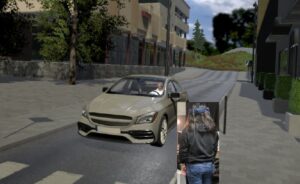 | Hiroshi Furuya; Kangsoo Kim; Gerd Bruder; Pamela J. Wisniewski; Gregory F. Welch Autonomous Vehicle Visual Embodiment for Pedestrian Interactions in Crossing Scenarios: Virtual Drivers in AVs for Pedestrian Crossing Proceedings Article In: Extended Abstracts of the 2021 CHI Conference on Human Factors in Computing Systems, pp. 7, Association for Computing Machinery, New York, NY, USA, 2021, ISBN: 9781450380959. @inproceedings{Furuya2021,
title = {Autonomous Vehicle Visual Embodiment for Pedestrian Interactions in Crossing Scenarios: Virtual Drivers in AVs for Pedestrian Crossing},
author = {Hiroshi Furuya and Kangsoo Kim and Gerd Bruder and Pamela J. Wisniewski and Gregory F. Welch},
url = {https://sreal.ucf.edu/wp-content/uploads/2021/06/Furuya2021.pdf},
doi = {10.1145/3411763.3451626},
isbn = {9781450380959},
year = {2021},
date = {2021-05-08},
booktitle = {Extended Abstracts of the 2021 CHI Conference on Human Factors in Computing Systems},
number = {304},
pages = {7},
publisher = {Association for Computing Machinery},
address = {New York, NY, USA},
series = {CHI EA'21},
abstract = {This work presents a novel prototype autonomous vehicle (AV) human-machine interface (HMI) in virtual reality (VR) that utilizes a human-like visual embodiment in the driver's seat of an AV to communicate AV intent to pedestrians in a crosswalk scenario. There is currently a gap in understanding the use of virtual humans in AV HMIs for pedestrian crossing despite the demonstrated efficacy of human-like interfaces in improving human-machine relationships. We conduct a 3x2 within-subjects experiment in VR using our prototype to assess the effects of a virtual human visual embodiment AV HMI on pedestrian crossing behavior and experience. In the experiment participants walk across a virtual crosswalk in front of an AV. How long they took to decide to cross and how long it took for them to reach the other side were collected, in addition to their subjective preferences and feelings of safety. Of 26 participants, 25 preferred the condition with the most anthropomorphic features. An intermediate condition where a human-like virtual driver was present but did not exhibit any behaviors was least preferred and also had a significant effect on time to decide. This work contributes the first empirical work on using human-like visual embodiments for AV HMIs.},
keywords = {},
pubstate = {published},
tppubtype = {inproceedings}
}
This work presents a novel prototype autonomous vehicle (AV) human-machine interface (HMI) in virtual reality (VR) that utilizes a human-like visual embodiment in the driver's seat of an AV to communicate AV intent to pedestrians in a crosswalk scenario. There is currently a gap in understanding the use of virtual humans in AV HMIs for pedestrian crossing despite the demonstrated efficacy of human-like interfaces in improving human-machine relationships. We conduct a 3x2 within-subjects experiment in VR using our prototype to assess the effects of a virtual human visual embodiment AV HMI on pedestrian crossing behavior and experience. In the experiment participants walk across a virtual crosswalk in front of an AV. How long they took to decide to cross and how long it took for them to reach the other side were collected, in addition to their subjective preferences and feelings of safety. Of 26 participants, 25 preferred the condition with the most anthropomorphic features. An intermediate condition where a human-like virtual driver was present but did not exhibit any behaviors was least preferred and also had a significant effect on time to decide. This work contributes the first empirical work on using human-like visual embodiments for AV HMIs. |