2026
|
 | Zubin Datta Choudhary; Lee Lisle; Gerd Bruder; Greg Welch Rare Events, Costly Switches: How Attentional Distribution Asymmetry Modulates Switching Costs across Augmented Reality and the Real World Proceedings Article Forthcoming In: ACM Symposium on Spatial User Interaction (SUI '26), Forthcoming. @inproceedings{Choudhary2026c,
title = {Rare Events, Costly Switches: How Attentional Distribution Asymmetry Modulates Switching Costs across Augmented Reality and the Real World},
author = {Zubin Datta Choudhary and Lee Lisle and Gerd Bruder and Greg Welch},
url = {https://sreal.ucf.edu/wp-content/uploads/2026/10/sui26-4.pdf},
doi = {10.1145/3822518.3830044},
year = {2026},
date = {2026-10-10},
booktitle = {ACM Symposium on Spatial User Interaction (SUI '26)},
abstract = {Augmented reality (AR) systems require users to distribute visual attention across virtual content and the physical world simultaneously. When this distribution is unequal, switching visual attention between the two sources may incur additional cognitive overhead. In this paper, we present a controlled within-subjects experiment in which participants completed an adapted Paced Visual Serial Addition Test (PVSAT) with an AR stimulus and a non-AR stimulus under five presentation ratios (9:1, 3:1, 1:1, 1:3, 1:9; for non-AR : AR), operationalized as a proxy for attentional distribution. Switch trials were significantly slower than repeat trials. Costs were larger under more extreme distributions on both sides of the ratio spectrum. Transitions toward the AR display were slower on average than transitions away from it, independent of ratio. Both effects appeared in response time alone; neither accuracy nor subjective workload differed. We discuss implications of switching costs and attentional distributions for AR systems.},
keywords = {},
pubstate = {forthcoming},
tppubtype = {inproceedings}
}
Augmented reality (AR) systems require users to distribute visual attention across virtual content and the physical world simultaneously. When this distribution is unequal, switching visual attention between the two sources may incur additional cognitive overhead. In this paper, we present a controlled within-subjects experiment in which participants completed an adapted Paced Visual Serial Addition Test (PVSAT) with an AR stimulus and a non-AR stimulus under five presentation ratios (9:1, 3:1, 1:1, 1:3, 1:9; for non-AR : AR), operationalized as a proxy for attentional distribution. Switch trials were significantly slower than repeat trials. Costs were larger under more extreme distributions on both sides of the ratio spectrum. Transitions toward the AR display were slower on average than transitions away from it, independent of ratio. Both effects appeared in response time alone; neither accuracy nor subjective workload differed. We discuss implications of switching costs and attentional distributions for AR systems. |
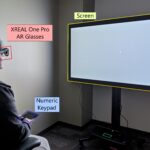
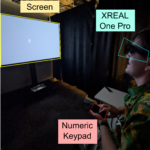 | Zubin Datta Choudhary; Lee Lisle; Ahinya Alwin; Gred Bruder; Greg Welch Cognitive Performance During Display Switching in Optical See-Through Augmented Reality Proceedings Article In: 25th IEEE International Symposium on Mixed and Augmented Reality (ISMAR), 2026. @inproceedings{Choudhary2026d,
title = {Cognitive Performance During Display Switching in Optical See-Through Augmented Reality},
author = {Zubin Datta Choudhary and Lee Lisle and Ahinya Alwin and Gred Bruder and Greg Welch },
url = {https://sreal.ucf.edu/wp-content/uploads/2026/10/cam-ready_DisplaySwitching_1.pdf},
year = {2026},
date = {2026-10-05},
urldate = {2026-10-05},
booktitle = {25th IEEE International Symposium on Mixed and Augmented Reality (ISMAR)},
journal = {25th IEEE International Symposium on Mixed and Augmented Reality (ISMAR)},
abstract = {Optical see-through (OST) augmented reality (AR) displays can render virtual content directly in the user's view of the physical world. In certain use cases, the physical world can include fixed emissive displays. For example, pilots, ship captains, and power plant operators equipped with AR displays might switch their visual attention between AR elements, physical interface components, and imagery on emissive flat panel displays fixed in the environment. Switching attention between these targets involves aspects of dynamic perception and cognition. We conducted a controlled study using XREAL One Pro AR glasses to examine the cognitive effects of switching attention between content displayed on a nearby flat panel display (FPD)/ screen and content displayed on a head-worn AR display (HWD), under two ambient brightness levels (10 lux and 150 lux). Participants completed an adapted Paced Visual Serial Addition Test (PVSAT), a continuous cognitive task that measures information processing speed and working memory under sustained demand, while switching between displays on every trial. Contrary to expectation, we found no general cost of switching over repeating a display. Instead, performance costs were specific to the direction of the transition: transitioning to the screen was significantly slower than transitioning to the HWD, no matter where the transition began. Higher ambient brightness improved response speed, reduced missed trials, and did not increase subjective visual fatigue. These findings suggest that in unpredictable multi-display environments, what display you transition to matters as much as the act of switching itself, with implications for the design of OST AR interfaces where transitions between head-worn and external displays are frequent. },
keywords = {},
pubstate = {published},
tppubtype = {inproceedings}
}
Optical see-through (OST) augmented reality (AR) displays can render virtual content directly in the user's view of the physical world. In certain use cases, the physical world can include fixed emissive displays. For example, pilots, ship captains, and power plant operators equipped with AR displays might switch their visual attention between AR elements, physical interface components, and imagery on emissive flat panel displays fixed in the environment. Switching attention between these targets involves aspects of dynamic perception and cognition. We conducted a controlled study using XREAL One Pro AR glasses to examine the cognitive effects of switching attention between content displayed on a nearby flat panel display (FPD)/ screen and content displayed on a head-worn AR display (HWD), under two ambient brightness levels (10 lux and 150 lux). Participants completed an adapted Paced Visual Serial Addition Test (PVSAT), a continuous cognitive task that measures information processing speed and working memory under sustained demand, while switching between displays on every trial. Contrary to expectation, we found no general cost of switching over repeating a display. Instead, performance costs were specific to the direction of the transition: transitioning to the screen was significantly slower than transitioning to the HWD, no matter where the transition began. Higher ambient brightness improved response speed, reduced missed trials, and did not increase subjective visual fatigue. These findings suggest that in unpredictable multi-display environments, what display you transition to matters as much as the act of switching itself, with implications for the design of OST AR interfaces where transitions between head-worn and external displays are frequent. |
 | Zachmann, Gabriel; Haddawy, Peter; Kikinis, Ron; Hennemuth, Anja; Cattin, Philippe C.; Döring, Tanja; Drouin, Simon; Fichtinger, Gabor; Flügge, Tabea; Jorge, Joaquim A.; Kohli, Luv; Lorenz, Mario; Malaka, Rainer; Pascau, Javier; Reiners, Dirk; V. Reinschluessel, Anke; Schenk, Andrea; Schmid, Falko; Suebnukarn, Siriwan; Uslar, Verena; Welch, Gregory F.; Weller, Rene; Weyhe, Dirk; Yin, Myat Su; Wijewickrema, Sudanthi Extended Reality for Enhancing Surgery: Research Directions to Transform the Operating Environment Journal Article In: Journal of Healthcare Informatics Research, 2026. @article{Zachmann2026aa,
title = {Extended Reality for Enhancing Surgery: Research Directions to Transform the Operating Environment},
author = {Zachmann, Gabriel and Haddawy, Peter and Kikinis, Ron and Hennemuth, Anja and Cattin, Philippe C. and Döring, Tanja and Drouin, Simon and Fichtinger, Gabor and Flügge, Tabea and Jorge, Joaquim A. and Kohli, Luv and Lorenz, Mario and Malaka, Rainer and Pascau, Javier and Reiners, Dirk and V. Reinschluessel, Anke and Schenk, Andrea and Schmid, Falko and Suebnukarn, Siriwan and Uslar, Verena and Welch, Gregory F. and Weller, Rene and Weyhe, Dirk and Yin, Myat Su and Wijewickrema, Sudanthi},
url = {https://sreal.ucf.edu/wp-content/uploads/2026/08/Zachmann2026aa.pdf
https://link.springer.com/article/10.1007/s41666-026-00250-y},
doi = {10.1007/s41666-026-00250-y},
year = {2026},
date = {2026-08-11},
urldate = {2026-08-11},
journal = {Journal of Healthcare Informatics Research},
abstract = {In the past decade, virtual reality (VR) and augmented reality (AR) have seen a second wave of activity due to consumer-level availability of devices. In the medical realm, use of VR and AR has been investigated extensively and successfully for training, teaching, rehabilitation, and therapy. However, extended reality (XR) and its intraoperative use in the operating room has yet been underexplored and underdeveloped. Intelligent XR environments that integrate advanced visualization, intuitive interaction, and AI-assisted decision support have the potential to transform clinical care. Responsive, context-aware spaces could enhance medical teams’capabilities by enabling real-time access to critical information, enhancing situation awareness, and supporting remote collaboration and access to clinical expertise across geographical boundaries—all while preserving the natural flow of procedures. But to realize the potential benefits of XR in the operating room requires a significant and focused effort by an interdisciplinary community. It is the intention of this paper to help to catalyze such an effort. In this paper, we identify pressing issues in clinical care, the potential of XR to address them, and the further research that is needed to realize that potential. We look at a broad range of areas where XR can play an important role, including direct support for the surgeon, support for the surgical team, support for the patient, and remote collaboration. We also consider ways in which XR can be integrated with AI to provide enhanced information and interaction. Discussions are underpinned by considerations of methods to evaluate contributions and progress. This paper is the result of a Dagstuhl Seminar on Extended Reality for the Operating Room (XR4OR), held at the Leibniz Center for Informatics, Schloss Dagstuhl, Germany, in February 2025. It gathered twenty-four researchers working in the areas of virtual reality, augmented reality, medical informatics, human-computer interaction, and surgery.},
keywords = {},
pubstate = {published},
tppubtype = {article}
}
In the past decade, virtual reality (VR) and augmented reality (AR) have seen a second wave of activity due to consumer-level availability of devices. In the medical realm, use of VR and AR has been investigated extensively and successfully for training, teaching, rehabilitation, and therapy. However, extended reality (XR) and its intraoperative use in the operating room has yet been underexplored and underdeveloped. Intelligent XR environments that integrate advanced visualization, intuitive interaction, and AI-assisted decision support have the potential to transform clinical care. Responsive, context-aware spaces could enhance medical teams’capabilities by enabling real-time access to critical information, enhancing situation awareness, and supporting remote collaboration and access to clinical expertise across geographical boundaries—all while preserving the natural flow of procedures. But to realize the potential benefits of XR in the operating room requires a significant and focused effort by an interdisciplinary community. It is the intention of this paper to help to catalyze such an effort. In this paper, we identify pressing issues in clinical care, the potential of XR to address them, and the further research that is needed to realize that potential. We look at a broad range of areas where XR can play an important role, including direct support for the surgeon, support for the surgical team, support for the patient, and remote collaboration. We also consider ways in which XR can be integrated with AI to provide enhanced information and interaction. Discussions are underpinned by considerations of methods to evaluate contributions and progress. This paper is the result of a Dagstuhl Seminar on Extended Reality for the Operating Room (XR4OR), held at the Leibniz Center for Informatics, Schloss Dagstuhl, Germany, in February 2025. It gathered twenty-four researchers working in the areas of virtual reality, augmented reality, medical informatics, human-computer interaction, and surgery. |
 | Kailei Yan; Gregory F. F. Welch; Lisa Mills; Usha Menon; Ukamaka Oruche; Alexander Burtzos; David Asakitogum; Victoria Loerzel Scene designs and user experience of VR interventions to manage symptoms among cancer populations: a systematic review of qualitative studies Journal Article In: Frontiers in Virtual Reality, vol. Volume 7 - 2026, 2026, ISSN: 2673-4192. @article{Yan2026aa,
title = {Scene designs and user experience of VR interventions to manage symptoms among cancer populations: a systematic review of qualitative studies},
author = {Kailei Yan and Gregory F. F. Welch and Lisa Mills and Usha Menon and Ukamaka Oruche and Alexander Burtzos and David Asakitogum and Victoria Loerzel},
url = {https://www.frontiersin.org/journals/virtual-reality/articles/10.3389/frvir.2026.1862031
https://sreal.ucf.edu/wp-content/uploads/2026/07/Yan2026aa.pdf},
doi = {10.3389/frvir.2026.1862031},
issn = {2673-4192},
year = {2026},
date = {2026-06-25},
urldate = {2026-06-25},
journal = {Frontiers in Virtual Reality},
volume = {Volume 7 - 2026},
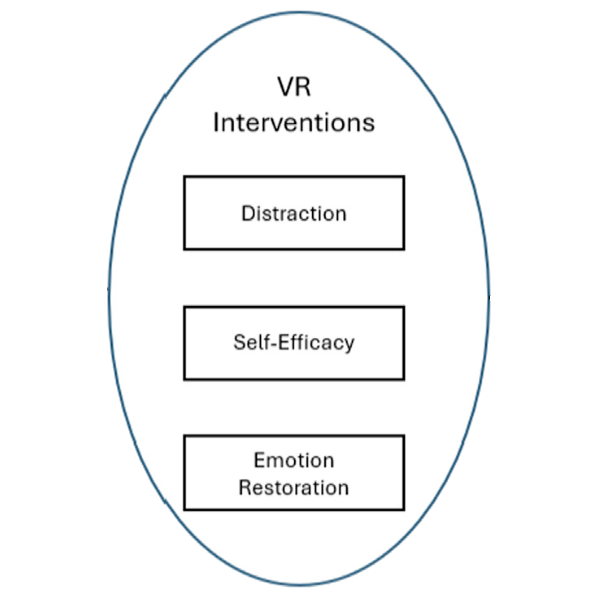
abstract = {PurposeThis study systematically reviewed how virtual reality (VR) interventions have been understood in symptom management from perspectives of both intervention designers and individuals with cancer, and we derived a model of VR interventions for cancer symptom management.MethodsA systematic review of qualitative studies was conducted across five databases, including the Cochrane Library of Systematic reviews, PubMed, PsycInfo, ScienceDirect, and Scopus. Studies were identified and evaluated using the standard Joanna Briggs Institute Critical Appraisal Checklist for Qualitative Research.ResultsA total of 20 qualitative studies was included in this review. We found seven categories in terms of how VR interventions were designed: 1) immersion and presence as therapeutic support for distraction, 2) multi-sensory content for positive emotion restoration, 3) interactivity and embodiment for engagement and motivation, 4) personalization for resonance, 5) real-world versus computer-generated content, 6) integration with clinical workflow, and 7) purposes of using VR. Seven categories reflecting how VR was perceived by individuals with cancer were identified: 1) ease of use, 2) perceived usefulness for treatment support, 3) enjoyment, satisfaction, and hedonic quality, 4) symptom and functioning benefits, 5) innovativeness and openness to technology, 6) cybersickness and tolerability, and 7) accessibility and flexible use. Based on these categories from designers and participants’ perspectives, three themes of distinct VR mechanisms in symptom management interventions were identified: 1) distraction, 2) self-efficacy improvement, and 3) emotion restoration.ConclusionBased on qualitative evidence of how cancer patients and researchers actually experience VR, we developed a conceptual framework to advance the understanding of the unique nature and implementation of VR interventions in cancer symptom management.Systematic Review Registrationhttps://www.crd.york.ac.uk/PROSPERO/view/CRD42025642992, identifier CRD42025642992.},
keywords = {},
pubstate = {published},
tppubtype = {article}
}
PurposeThis study systematically reviewed how virtual reality (VR) interventions have been understood in symptom management from perspectives of both intervention designers and individuals with cancer, and we derived a model of VR interventions for cancer symptom management.MethodsA systematic review of qualitative studies was conducted across five databases, including the Cochrane Library of Systematic reviews, PubMed, PsycInfo, ScienceDirect, and Scopus. Studies were identified and evaluated using the standard Joanna Briggs Institute Critical Appraisal Checklist for Qualitative Research.ResultsA total of 20 qualitative studies was included in this review. We found seven categories in terms of how VR interventions were designed: 1) immersion and presence as therapeutic support for distraction, 2) multi-sensory content for positive emotion restoration, 3) interactivity and embodiment for engagement and motivation, 4) personalization for resonance, 5) real-world versus computer-generated content, 6) integration with clinical workflow, and 7) purposes of using VR. Seven categories reflecting how VR was perceived by individuals with cancer were identified: 1) ease of use, 2) perceived usefulness for treatment support, 3) enjoyment, satisfaction, and hedonic quality, 4) symptom and functioning benefits, 5) innovativeness and openness to technology, 6) cybersickness and tolerability, and 7) accessibility and flexible use. Based on these categories from designers and participants’ perspectives, three themes of distinct VR mechanisms in symptom management interventions were identified: 1) distraction, 2) self-efficacy improvement, and 3) emotion restoration.ConclusionBased on qualitative evidence of how cancer patients and researchers actually experience VR, we developed a conceptual framework to advance the understanding of the unique nature and implementation of VR interventions in cancer symptom management.Systematic Review Registrationhttps://www.crd.york.ac.uk/PROSPERO/view/CRD42025642992, identifier CRD42025642992. |
 | Zubin Datta Choudhary; Matt Gottsacker; Hiroshi Furuya; Austin Erickson; Ryan Schubert; Gerd Bruder; Michael P. Browne; Greg Welch Elucidating the Effects of Augmented Reality Head-Worn Display Factors on Performance, Trust, and Behavior Journal Article In: IEEE Transactions on Visualization and Computer Graphics, 2026, ISSN: 1941-0506. @article{Choudhary2026TrustARDisplayFactors,
title = {Elucidating the Effects of Augmented Reality Head-Worn Display Factors on Performance, Trust, and Behavior},
author = {Zubin Datta Choudhary and Matt Gottsacker and Hiroshi Furuya and Austin Erickson and Ryan Schubert and Gerd Bruder and Michael P. Browne and Greg Welch},
url = {https://sreal.ucf.edu/wp-content/uploads/2026/07/Elucidating_the_Effects_of_Augmented_Reality_Head-Worn_Display_Factors_on_Performance_Trust_and_Behavior.pdf},
doi = {10.1109/TVCG.2026.3703957},
issn = {1941-0506},
year = {2026},
date = {2026-06-16},
urldate = {2026-06-16},
journal = {IEEE Transactions on Visualization and Computer Graphics},
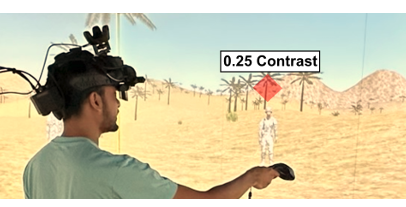
abstract = {Augmented reality (AR) display characteristics have the potential to either enhance or impair users' spatial abilities and performance. While previous work included studies of spatial performance with various display factors, evidence for objective performance differences is limited due to compensatory behaviors employed by users and overall behavioral differences. In general, it is challenging to document the effects of display factors on task performance as they depend on users' task behaviors, which in turn depend on users' reliance and trust in the technology, which are also affected by the display factors. In this paper, we present two within-subjects experiments (each N=20) in which we aim to elucidate some of the interrelations between two AR display factors (field of view and visual contrast) with objective task performance and subjective assessments of reliance and trust, while controlling for different behaviors. Participants performed a 360∘ search-and-selection task in a unique hybrid setup, in which we simulated a controlled task environment by having participants stand inside an immersive CAVE-like space while at the same time wearing a head-worn display that overlaid AR tags over the simulated environment. Specifically, we evaluated three fields of view (43∘, 93∘, and 143∘) and three visual contrasts (0.05, 0.25, and 0.5). We controlled for four different behaviors: AR-Only (only relying on AR), AR-First (prioritizing AR over real world), Real-First (prioritizing real world over AR), and Real-Only (only relying on real world). By controlling for these behaviors, we were able to show objective and subjective benefits of larger fields of view and visual contrast. We illustrate how the controlled behaviors relate to users' subjective reliance and trust in an AR system, and why it is important for researchers and practitioners to understand these subjective and behavioral aspects.},
keywords = {},
pubstate = {published},
tppubtype = {article}
}
Augmented reality (AR) display characteristics have the potential to either enhance or impair users' spatial abilities and performance. While previous work included studies of spatial performance with various display factors, evidence for objective performance differences is limited due to compensatory behaviors employed by users and overall behavioral differences. In general, it is challenging to document the effects of display factors on task performance as they depend on users' task behaviors, which in turn depend on users' reliance and trust in the technology, which are also affected by the display factors. In this paper, we present two within-subjects experiments (each N=20) in which we aim to elucidate some of the interrelations between two AR display factors (field of view and visual contrast) with objective task performance and subjective assessments of reliance and trust, while controlling for different behaviors. Participants performed a 360∘ search-and-selection task in a unique hybrid setup, in which we simulated a controlled task environment by having participants stand inside an immersive CAVE-like space while at the same time wearing a head-worn display that overlaid AR tags over the simulated environment. Specifically, we evaluated three fields of view (43∘, 93∘, and 143∘) and three visual contrasts (0.05, 0.25, and 0.5). We controlled for four different behaviors: AR-Only (only relying on AR), AR-First (prioritizing AR over real world), Real-First (prioritizing real world over AR), and Real-Only (only relying on real world). By controlling for these behaviors, we were able to show objective and subjective benefits of larger fields of view and visual contrast. We illustrate how the controlled behaviors relate to users' subjective reliance and trust in an AR system, and why it is important for researchers and practitioners to understand these subjective and behavioral aspects. |
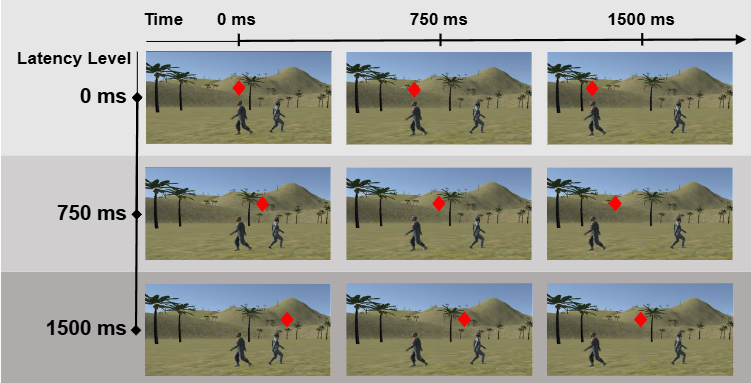 | Hiroshi Furuya; Matthew Gottsacker; Zubin Datta Choudhary; Austin Erickson; Ryan Schubert; Gerd Bruder; Michael P. Browne; Gregory F. Welch User Performance and Trust with Network-Connected Augmented Reality Head-Worn Displays in Unstable Network Environments Journal Article In: ACM Transactions on Applied Perception, 2026, ISSN: 1544-3558. @article{Furuya2026TrustNetworkAR,
title = {User Performance and Trust with Network-Connected Augmented Reality Head-Worn Displays in Unstable Network Environments},
author = {Hiroshi Furuya and Matthew Gottsacker and Zubin Datta Choudhary and Austin Erickson and Ryan Schubert and Gerd Bruder and Michael P. Browne and Gregory F. Welch},
url = {https://sreal.ucf.edu/wp-content/uploads/2026/07/3822592.pdf},
doi = {10.1145/3822592},
issn = {1544-3558},
year = {2026},
date = {2026-06-04},
journal = {ACM Transactions on Applied Perception},
keywords = {},
pubstate = {published},
tppubtype = {article}
}
|
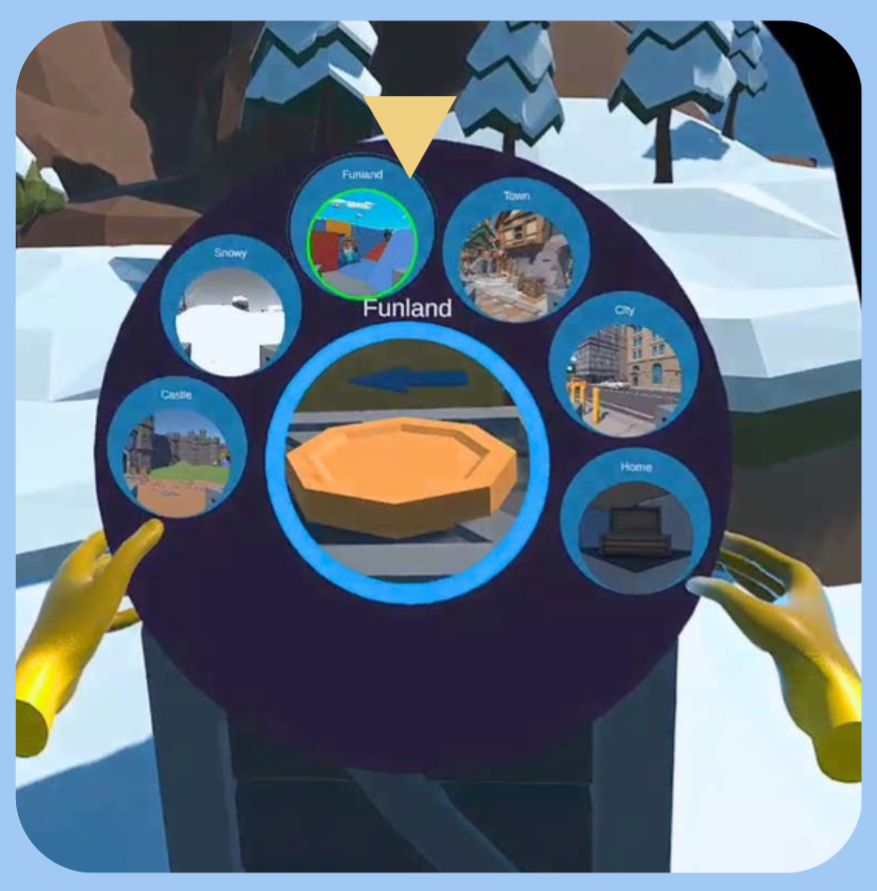 | Matt Gottsacker; Yahya Hmaiti; Mykola Maslych; Hiroshi Furuya; Jasmine Joyce DeGuzman; Gerd Bruder; Gregory F. Welch; Joseph J. LaViola Jr. From One World to Another: Interfaces for Efficiently Transitioning Between Virtual Environments Proceedings Article In: ACM CHI Conference on Human Factors in Computing Systems (CHI '26), pp. 1-17, 2026. @inproceedings{gottsacker2026worldswitch,
title = {From One World to Another: Interfaces for Efficiently Transitioning Between Virtual Environments},
author = {Matt Gottsacker and Yahya Hmaiti and Mykola Maslych and Hiroshi Furuya and Jasmine Joyce DeGuzman and Gerd Bruder and Gregory F. Welch and Joseph J. LaViola Jr.},
url = {https://sreal.ucf.edu/wp-content/uploads/2026/02/CHI2026___FullPaper__WorldSwitchUI-4.pdf},
doi = {10.1145/3772318.3791912},
year = {2026},
date = {2026-04-13},
urldate = {2026-04-13},
booktitle = {ACM CHI Conference on Human Factors in Computing Systems (CHI '26)},
pages = {1-17},
abstract = {Personal computers and handheld devices provide keyboard shortcuts and swipe gestures to enable users to efficiently switch between applications, whereas today's virtual reality (VR) systems do not. In this work, we present an exploratory study on user interface aspects to support efficient switching between worlds in VR. We created eight interfaces that afford previewing and selecting from the available virtual worlds, including methods using portals and worlds-in-miniature (WiMs). To evaluate these methods, we conducted a controlled within-subjects empirical experiment (N=22) where participants frequently transitioned between six different environments to complete an object collection task. Our quantitative and qualitative results show that WiMs supported rapid acquisition of high-level spatial information while searching and were deemed most efficient by participants while portals provided fast pre-orientation. Finally, we present insights into the applicability, usability, and effectiveness of the VR world switching methods we explored, and provide recommendations for their application and future context/world switching techniques and interfaces.},
keywords = {},
pubstate = {published},
tppubtype = {inproceedings}
}
Personal computers and handheld devices provide keyboard shortcuts and swipe gestures to enable users to efficiently switch between applications, whereas today's virtual reality (VR) systems do not. In this work, we present an exploratory study on user interface aspects to support efficient switching between worlds in VR. We created eight interfaces that afford previewing and selecting from the available virtual worlds, including methods using portals and worlds-in-miniature (WiMs). To evaluate these methods, we conducted a controlled within-subjects empirical experiment (N=22) where participants frequently transitioned between six different environments to complete an object collection task. Our quantitative and qualitative results show that WiMs supported rapid acquisition of high-level spatial information while searching and were deemed most efficient by participants while portals provided fast pre-orientation. Finally, we present insights into the applicability, usability, and effectiveness of the VR world switching methods we explored, and provide recommendations for their application and future context/world switching techniques and interfaces. |
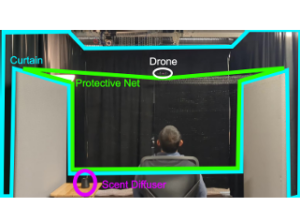 | Hiroshi Furuya; Jasmine Joyce DeGuzman; Zubin Datta Choudhary; Matt Gottsacker; Ahinya Alwin; Lee Lisle; Gerd Bruder; Gregory F Welch Effects of Multisensory Feedback and Real-World Priming on Presence and Copresence in Mixed Reality Drone Simulation Proceedings Article In: Proceedings of the 2026 IEEE Conference on Virtual Reality and 3D User Interfaces Abstracts and Workshops (IEEE VRW): 2nd Annual Workshop on Real and Virtual Spaces Influences (ReVISI), pp. 1-7, 2026. @inproceedings{furuya-real-world-priming-26,
title = {Effects of Multisensory Feedback and Real-World Priming on Presence and Copresence in Mixed Reality Drone Simulation},
author = {Hiroshi Furuya and Jasmine Joyce DeGuzman and Zubin Datta Choudhary and Matt Gottsacker and Ahinya Alwin and Lee Lisle and Gerd Bruder and Gregory F Welch},
url = {https://sreal.ucf.edu/wp-content/uploads/2026/02/VR26_Revisi__Real_World_Priming_for_VR_Experiences-3.pdf},
year = {2026},
date = {2026-03-21},
urldate = {2026-03-21},
booktitle = {Proceedings of the 2026 IEEE Conference on Virtual Reality and 3D User Interfaces Abstracts and Workshops (IEEE VRW): 2nd Annual Workshop on Real and Virtual Spaces Influences (ReVISI)},
pages = {1-7},
abstract = {Virtual reality (VR) experiences often rely on multisensory cues and realistic interactions to support convincing interpretations of virtual events and agents. This study examines how two factors, real-world priming and multisensory feedback, shape users’ perceptions of a virtual drone in a mixed-reality simulation. We conducted a mixed-design experiment where participants experienced either a physical drone flyover or no physical drone encounter, followed by audiovisual and multisensory drone flyovers in VR. Multisensory feedback increased co-presence and perceived realism specifically for participants who had encountered the real drone. In contrast, neither manipulation significantly affected standard presence measures. These findings highlight distinctions among presence-related constructs and suggest that recent real-world experiences can make certain multisensory cues be perceived as more realistic, even when they do not increase presence itself.},
keywords = {},
pubstate = {published},
tppubtype = {inproceedings}
}
Virtual reality (VR) experiences often rely on multisensory cues and realistic interactions to support convincing interpretations of virtual events and agents. This study examines how two factors, real-world priming and multisensory feedback, shape users’ perceptions of a virtual drone in a mixed-reality simulation. We conducted a mixed-design experiment where participants experienced either a physical drone flyover or no physical drone encounter, followed by audiovisual and multisensory drone flyovers in VR. Multisensory feedback increased co-presence and perceived realism specifically for participants who had encountered the real drone. In contrast, neither manipulation significantly affected standard presence measures. These findings highlight distinctions among presence-related constructs and suggest that recent real-world experiences can make certain multisensory cues be perceived as more realistic, even when they do not increase presence itself. |
 | Ahinya Alwin; Matthew Gottsacker; Hiroshi Furuya; Lee Lisle; Gerd Bruder; Gregory F. Welch Moving Towards Visibility Evaluation in Augmented Reality Using Simulated Environments and Continuous Psychophysics Proceedings Article In: Proceedings of the 2026 IEEE Conference on Virtual Reality and 3D User Interfaces Abstracts and Workshops (IEEE VRW): Third International Workshop on Perception-driven Graphics and Displays for VR and AR (PerGraVAR), 2026. @inproceedings{Alwin2026b,
title = {Moving Towards Visibility Evaluation in Augmented Reality Using Simulated Environments and Continuous Psychophysics},
author = {Ahinya Alwin and Matthew Gottsacker and Hiroshi Furuya and Lee Lisle and Gerd Bruder and Gregory F. Welch},
url = {https://sreal.ucf.edu/ieee_vr_2026_workshops_pergravar__visibility_evaluation_in_augmented_reality_using_simulated_environments_and_continuous_psychophysics_013026/},
year = {2026},
date = {2026-03-21},
urldate = {2026-03-21},
booktitle = {Proceedings of the 2026 IEEE Conference on Virtual Reality and 3D User Interfaces Abstracts and Workshops (IEEE VRW): Third International Workshop on Perception-driven Graphics and Displays for VR and AR (PerGraVAR)},
abstract = {Assessing the visibility of augmented reality (AR) cues in outdoor environments is challenging due to complex background structure, motion, and lighting variability. Simulating AR cues within virtual reality (VR) enables controlled manipulation and measurement of these factors while preserving immersive viewing conditions. This work presents a perception-driven methodology for evaluating AR cue visibility that combines simulated AR cues in VR, high resolution stereoscopic 360◦ video, and continuous psychophysics. Using this methodology, tracking-based performance data provide a continuous behavioral measure of visibility in complex scenes. Multiple analysis approaches are examined to support interpretation of tracking-based measures of perceptual performance in visually complex scenes. Together, this work illustrates progress toward a more ecologically valid and objective framework for studying AR cue visibility in outdoor settings.},
keywords = {},
pubstate = {published},
tppubtype = {inproceedings}
}
Assessing the visibility of augmented reality (AR) cues in outdoor environments is challenging due to complex background structure, motion, and lighting variability. Simulating AR cues within virtual reality (VR) enables controlled manipulation and measurement of these factors while preserving immersive viewing conditions. This work presents a perception-driven methodology for evaluating AR cue visibility that combines simulated AR cues in VR, high resolution stereoscopic 360◦ video, and continuous psychophysics. Using this methodology, tracking-based performance data provide a continuous behavioral measure of visibility in complex scenes. Multiple analysis approaches are examined to support interpretation of tracking-based measures of perceptual performance in visually complex scenes. Together, this work illustrates progress toward a more ecologically valid and objective framework for studying AR cue visibility in outdoor settings. |
 | Zubin Datta Choudhary; Ferran Argelaguet; Gerd Bruder; and Gregory F. Welch Teleportation Destination Previews Support Memory Retention During Virtual Navigation Proceedings Article In: Proceedings of the 2026 IEEE Conference on Virtual Reality and 3D User Interfaces (IEEE VR); Daegu, South Korea, March 21-25, 2026. @inproceedings{Choudhary2026,
title = {Teleportation Destination Previews Support Memory Retention During Virtual Navigation},
author = {Zubin Datta Choudhary and Ferran Argelaguet and Gerd Bruder and and Gregory F. Welch},
url = {https://sreal.ucf.edu/previews-effecting-memory/},
year = {2026},
date = {2026-03-21},
urldate = {2026-03-21},
booktitle = {Proceedings of the 2026 IEEE Conference on Virtual Reality and 3D User Interfaces (IEEE VR); Daegu, South Korea, March 21-25},
abstract = {Teleportation is one of the most widely used locomotion techniques in virtual reality (VR) because it is efficient, minimizes motion sickness, and enables large-scale spatial traversal with minimal effort. However, research on the Doorway Effect shows that spatial transitions can impair memory of information encountered just before the transition. Event Segmentation Theory (EST) explains this by proposing that salient changes disrupt a person’s working memory representation, causing recently encoded information to be replaced and reducing its availability for retrieval. By extension, the design of spatial transitions in VR may influence whether memory is disrupted or preserved, which could be a consideration in applied contexts such as education and training. One way to mitigate such impairment is to provide predictive cues about the upcoming change to reduce disruption. In VR, this can be implemented through teleportation previews, which give users a glimpse of the destination before arrival. In this experiment, we adapted the Doorway Effect paradigm to examine how two teleportation design factors — preview availability and environmental change — affect memory. Using a within-subjects 2 × 2 design (N = 27), participants studied a set of 3D objects, then teleported either within the same environment or into a different one, with or without a preview of the destination. After each transition, they completed a visual recognition task. Results showed two key findings: (1) without previews, recognition declined when teleporting into a different environment compared to remaining in the same one, and (2) when transitioning between different environments, providing a preview improved recognition relative to no preview. Together, these results indicate that both the distinctiveness of environments and the availability of previews shape memory during VR transitions. We discuss how these findings align with EST, highlight the cognitive consequences of teleportation design, and provide guidance for designing transitions that better support memory in applied contexts such as education and training.},
keywords = {},
pubstate = {published},
tppubtype = {inproceedings}
}
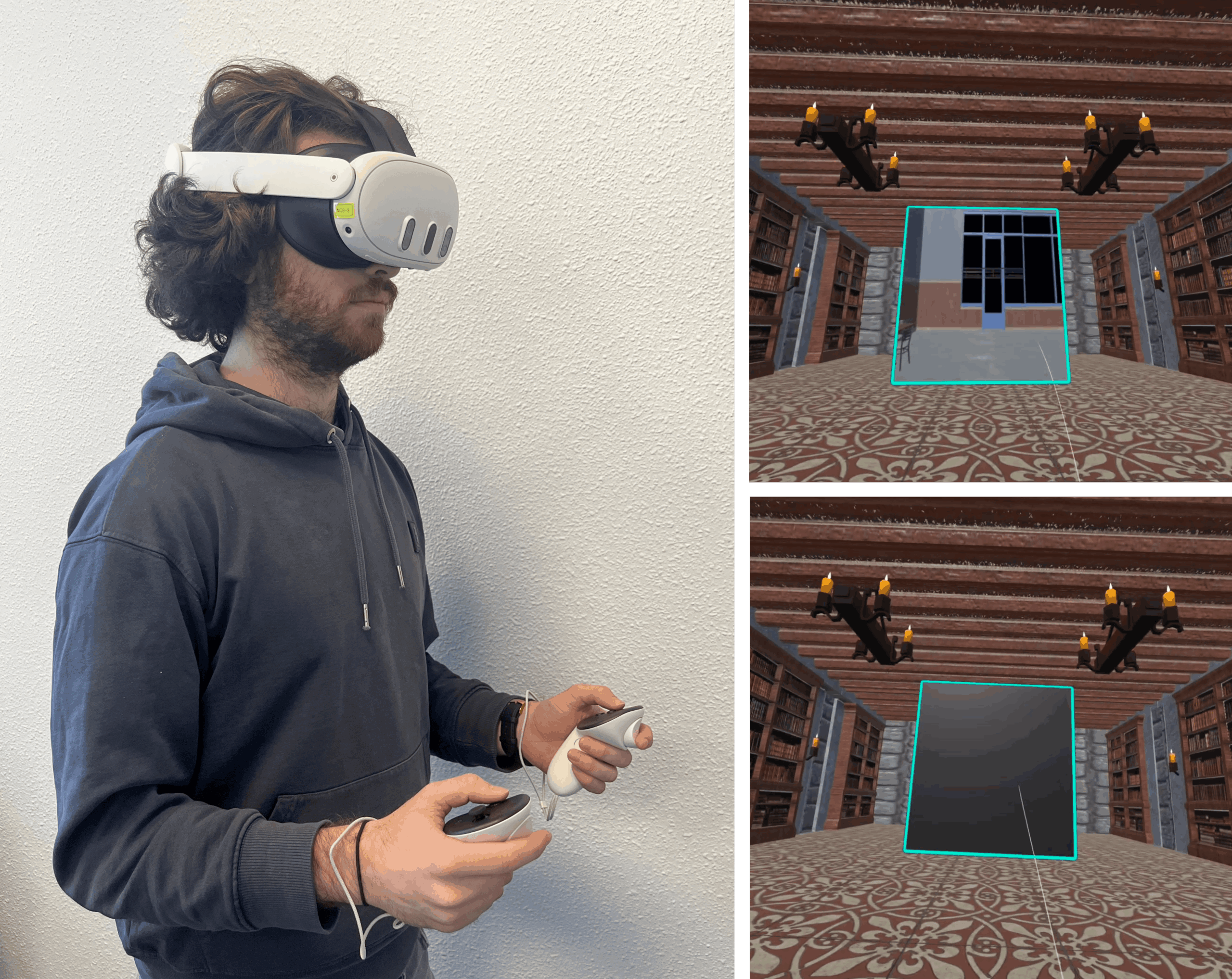
Teleportation is one of the most widely used locomotion techniques in virtual reality (VR) because it is efficient, minimizes motion sickness, and enables large-scale spatial traversal with minimal effort. However, research on the Doorway Effect shows that spatial transitions can impair memory of information encountered just before the transition. Event Segmentation Theory (EST) explains this by proposing that salient changes disrupt a person’s working memory representation, causing recently encoded information to be replaced and reducing its availability for retrieval. By extension, the design of spatial transitions in VR may influence whether memory is disrupted or preserved, which could be a consideration in applied contexts such as education and training. One way to mitigate such impairment is to provide predictive cues about the upcoming change to reduce disruption. In VR, this can be implemented through teleportation previews, which give users a glimpse of the destination before arrival. In this experiment, we adapted the Doorway Effect paradigm to examine how two teleportation design factors — preview availability and environmental change — affect memory. Using a within-subjects 2 × 2 design (N = 27), participants studied a set of 3D objects, then teleported either within the same environment or into a different one, with or without a preview of the destination. After each transition, they completed a visual recognition task. Results showed two key findings: (1) without previews, recognition declined when teleporting into a different environment compared to remaining in the same one, and (2) when transitioning between different environments, providing a preview improved recognition relative to no preview. Together, these results indicate that both the distinctiveness of environments and the availability of previews shape memory during VR transitions. We discuss how these findings align with EST, highlight the cognitive consequences of teleportation design, and provide guidance for designing transitions that better support memory in applied contexts such as education and training. |
![[Poster] Can You See It? Evaluating Color Visibility in Simulated Outdoor Environments](https://sreal.ucf.edu/wp-content/uploads/2026/02/teaser_AA-150x150.png) | Ahinya Alwin; Matthew Gottsacker; Hiroshi Furuya; Armin Delmo; Lee Lisle; Gerd Bruder; Gregory F. Welch [Poster] Can You See It? Evaluating Color Visibility in Simulated Outdoor Environments Proceedings Article In: Proceedings of IEEE Conference on Virtual Reality and 3D User Interfaces (IEEE VR) 2026., 2026. @inproceedings{Alwin2026_2,
title = {[Poster] Can You See It? Evaluating Color Visibility in Simulated Outdoor Environments},
author = {Ahinya Alwin and Matthew Gottsacker and Hiroshi Furuya and Armin Delmo and Lee Lisle and Gerd Bruder and Gregory F. Welch},
url = {https://sreal.ucf.edu/wp-content/uploads/2026/02/vr26b-sub1299-cam-i5.pdf},
year = {2026},
date = {2026-03-21},
urldate = {2026-03-21},
booktitle = {Proceedings of IEEE Conference on Virtual Reality and 3D User Interfaces (IEEE VR) 2026.},
journal = {Proceedings of IEEE Conference on Virtual Reality and 3D User Interfaces (IEEE VR) 2026, Daegu, South Korea.},
abstract = {Evaluating color visibility in outdoor augmented reality (AR) is challenging due to the visual complexity and variability of real world environments. Outdoor scenes feature diverse textures and lighting conditions, limiting the applicability of visibility evaluation methods developed for simple or static backgrounds. This work introduces a methodology for evaluating AR cue color visibility in an outdoor environment by sampling visibility across realistic scenes and identifying design considerations for evaluating color visibility under dynamic, visually complex conditions},
keywords = {},
pubstate = {published},
tppubtype = {inproceedings}
}
Evaluating color visibility in outdoor augmented reality (AR) is challenging due to the visual complexity and variability of real world environments. Outdoor scenes feature diverse textures and lighting conditions, limiting the applicability of visibility evaluation methods developed for simple or static backgrounds. This work introduces a methodology for evaluating AR cue color visibility in an outdoor environment by sampling visibility across realistic scenes and identifying design considerations for evaluating color visibility under dynamic, visually complex conditions |
2025
|
 | Matt Gottsacker; Yahya Hmaiti; Mykola Maslych; Hiroshi Furuya; Gerd Bruder; Gregory F Welch; Joseph J. LaViola Jr. From Alt-Tab to World-Snap: Exploring Different Metaphors for Swift and Seamless VR World Switching Proceedings Article In: IEEE International Symposium on Mixed and Augmented Reality, pp. 1-2, 2025. @inproceedings{nokey,
title = {From Alt-Tab to World-Snap: Exploring Different Metaphors for Swift and Seamless VR World Switching},
author = {Matt Gottsacker and Yahya Hmaiti and Mykola Maslych and Hiroshi Furuya and Gerd Bruder and Gregory F Welch and Joseph J. LaViola Jr.},
url = {https://sreal.ucf.edu/wp-content/uploads/2025/09/ISMAR25__Demo__VR_World_Switch_UI.pdf},
year = {2025},
date = {2025-10-08},
urldate = {2025-10-08},
booktitle = {IEEE International Symposium on Mixed and Augmented Reality},
pages = {1-2},
abstract = {Today's personal computers and handheld devices afford users the ability to rapidly switch between different applications, e.g., using keyboard shortcuts and swipe gestures. In today's virtual reality (VR) systems, immersive applications are siloed experiences that users must fully exit before starting another. We demonstrate eight prototypes of world switching interfaces that let users preview, select, and transition across multiple virtual environments in a continuous interaction, mirroring the ``Alt+Tab" agility of desktop multitasking. We developed these techniques based on portals and worlds-in-miniature (WiM) metaphors that reveal the destination environment before triggering a full transition. },
keywords = {},
pubstate = {published},
tppubtype = {inproceedings}
}
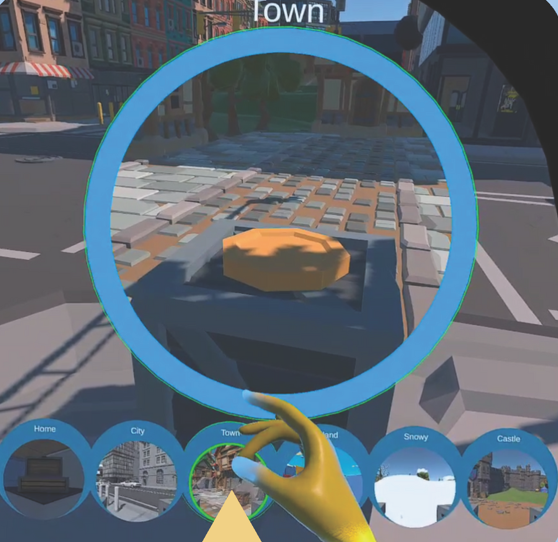
Today's personal computers and handheld devices afford users the ability to rapidly switch between different applications, e.g., using keyboard shortcuts and swipe gestures. In today's virtual reality (VR) systems, immersive applications are siloed experiences that users must fully exit before starting another. We demonstrate eight prototypes of world switching interfaces that let users preview, select, and transition across multiple virtual environments in a continuous interaction, mirroring the ``Alt+Tab" agility of desktop multitasking. We developed these techniques based on portals and worlds-in-miniature (WiM) metaphors that reveal the destination environment before triggering a full transition. |
 | Matt Gottsacker; Yahya Hmaiti; Mykola Maslych; Hiroshi Furuya; Gerd Bruder; Gregory F Welch; Joseph J. LaViola Jr. XR-First Design for Productivity: A Conceptual Framework for Enabling Efficient Task Switching in XR Proceedings Article In: IEEE International Symposium on Mixed and Augmented Reality (ISMAR) Adjunct Proceedings, 2025. @inproceedings{nokey,
title = {XR-First Design for Productivity: A Conceptual Framework for Enabling Efficient Task Switching in XR},
author = {Matt Gottsacker and Yahya Hmaiti and Mykola Maslych and Hiroshi Furuya and Gerd Bruder and Gregory F Welch and Joseph J. LaViola Jr.},
url = {https://sreal.ucf.edu/wp-content/uploads/2025/09/ISMAR25__Workshop_Paper__xrWORKS__VR_World_Switch_UI-11.pdf},
year = {2025},
date = {2025-10-08},
urldate = {2025-10-08},
booktitle = {IEEE International Symposium on Mixed and Augmented Reality (ISMAR) Adjunct Proceedings},
abstract = {A core component of completing tasks efficiently in computer supported knowledge work is the ability for users to rapidly switch their focus (and interaction) across different applications using various shortcuts and gestures. This feature set has been explored in research, and several modern consumer extended reality (XR) headsets now support loading multiple applications windows at once. However, many XR applications that are useful for knowledge work involve rich spatial information, which window-based metaphors do not sufficiently represent nor afford appropriate interaction. In modern XR headsets, such immersive applications run as siloed experiences, requiring the user to fully exit one before starting another. We present a vision for achieving an XR-first, user-centric paradigm for efficient context switching in XR to encourage and guide future research and development of XR context- and task-switching interfaces.},
keywords = {},
pubstate = {published},
tppubtype = {inproceedings}
}
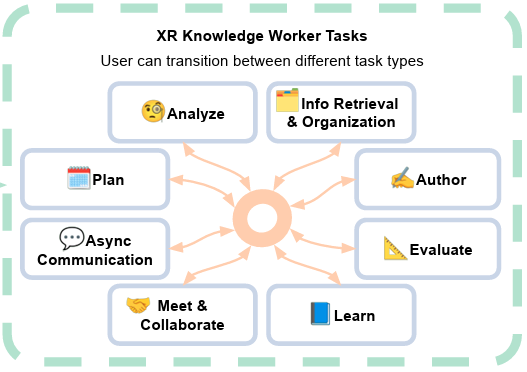
A core component of completing tasks efficiently in computer supported knowledge work is the ability for users to rapidly switch their focus (and interaction) across different applications using various shortcuts and gestures. This feature set has been explored in research, and several modern consumer extended reality (XR) headsets now support loading multiple applications windows at once. However, many XR applications that are useful for knowledge work involve rich spatial information, which window-based metaphors do not sufficiently represent nor afford appropriate interaction. In modern XR headsets, such immersive applications run as siloed experiences, requiring the user to fully exit one before starting another. We present a vision for achieving an XR-first, user-centric paradigm for efficient context switching in XR to encourage and guide future research and development of XR context- and task-switching interfaces. |
 | Matt Gottsacker; Nels Numan; Anthony Steed; Gerd Bruder; Gregory F. Welch; Steve Feiner Decoupled Hands: An Approach for Aligning Perspectives in Collaborative Mixed Reality Proceedings Article In: ACM CHI Conference on Human Factors in Computing Systems (CHI '25), 2025. @inproceedings{gottsacker2025perspectives,
title = {Decoupled Hands: An Approach for Aligning Perspectives in Collaborative Mixed Reality},
author = {Matt Gottsacker and Nels Numan and Anthony Steed and Gerd Bruder and Gregory F. Welch and Steve Feiner},
url = {https://sreal.ucf.edu/wp-content/uploads/2025/03/CHI25__LBW__MR_Perspective_Alignment_preprint.pdf},
doi = {10.1145/3706599.3720219},
year = {2025},
date = {2025-04-26},
urldate = {2025-04-26},
booktitle = {ACM CHI Conference on Human Factors in Computing Systems (CHI '25)},
abstract = {When collaborating relative to a shared 3D virtual object in mixed reality (MR), users may experience communication issues arising from differences in perspective. These issues include occlusion (e.g., one user not being able to see what the other is referring to) and inefficient spatial references (e.g., "to the left of this" may be confusing when users are positioned opposite to each other). This paper presents a novel technique for automatic perspective alignment in collaborative MR involving co-located interaction centered around a shared virtual object. To align one user’s perspective on the object with a collaborator’s, a local copy of the object and any other virtual elements that reference it (e.g., the collaborator’s hands) are dynamically transformed. The technique does not require virtual travel and preserves face-to-face interaction. We created a prototype application to demonstrate our technique and present an evaluation methodology for related MR collaboration and perspective alignment scenarios.},
keywords = {},
pubstate = {published},
tppubtype = {inproceedings}
}
When collaborating relative to a shared 3D virtual object in mixed reality (MR), users may experience communication issues arising from differences in perspective. These issues include occlusion (e.g., one user not being able to see what the other is referring to) and inefficient spatial references (e.g., "to the left of this" may be confusing when users are positioned opposite to each other). This paper presents a novel technique for automatic perspective alignment in collaborative MR involving co-located interaction centered around a shared virtual object. To align one user’s perspective on the object with a collaborator’s, a local copy of the object and any other virtual elements that reference it (e.g., the collaborator’s hands) are dynamically transformed. The technique does not require virtual travel and preserves face-to-face interaction. We created a prototype application to demonstrate our technique and present an evaluation methodology for related MR collaboration and perspective alignment scenarios. |
![[Poster] Inducing Unintentional Positional Drift (UPD) in Virtual Reality via Physical Rotations and the Illusion of Leaning](https://sreal.ucf.edu/wp-content/uploads/2025/03/Roll-Example-e1741105590923-150x150.jpg) | Zubin Datta Choudhary; Ferran Argelaguet; Gerd Bruder; Greg Welch [Poster] Inducing Unintentional Positional Drift (UPD) in Virtual Reality via Physical Rotations and the Illusion of Leaning Proceedings Article In: Proceedings of IEEE Conference on Virtual Reality and 3D User Interfaces (IEEE VR) 2025., 2025. @inproceedings{Choudhary2025,
title = {[Poster] Inducing Unintentional Positional Drift (UPD) in Virtual Reality via Physical Rotations and the Illusion of Leaning},
author = {Zubin Datta Choudhary and Ferran Argelaguet and Gerd Bruder and Greg Welch},
url = {https://sreal.ucf.edu/wp-content/uploads/2025/03/Camera-Ready_UPD_Roll_Poster_IEEE_VR_25.pdf},
year = {2025},
date = {2025-03-10},
urldate = {2025-03-10},
booktitle = {Proceedings of IEEE Conference on Virtual Reality and 3D User Interfaces (IEEE VR) 2025.},
abstract = {In Virtual Reality (VR) users often turn their bodies during experiences. Virtual navigation techniques use body rotations and virtual forward translations to simulate movement. Despite being designed for stationary use, these techniques can cause Unintentional Positional Drift (UPD), impacting user safety and VR experiences. We carried out a human-participant study, approved by our university ethics board, involving 20 participants performing repetitive rotation tasks. Our study focused on intentionally inducing UPD via physical rotations by adding an offset to the VR camera’s roll angle, creating a visual illusion of “leaning” or “banking.” Our results show that camera roll offsets induced UPD along participants initial left-right axis under specific conditions. Additionally, rotation magnitude and forward translation flow affected UPD, while no significant effects were found due to rotation direction.},
keywords = {},
pubstate = {published},
tppubtype = {inproceedings}
}
In Virtual Reality (VR) users often turn their bodies during experiences. Virtual navigation techniques use body rotations and virtual forward translations to simulate movement. Despite being designed for stationary use, these techniques can cause Unintentional Positional Drift (UPD), impacting user safety and VR experiences. We carried out a human-participant study, approved by our university ethics board, involving 20 participants performing repetitive rotation tasks. Our study focused on intentionally inducing UPD via physical rotations by adding an offset to the VR camera’s roll angle, creating a visual illusion of “leaning” or “banking.” Our results show that camera roll offsets induced UPD along participants initial left-right axis under specific conditions. Additionally, rotation magnitude and forward translation flow affected UPD, while no significant effects were found due to rotation direction. |
 | Hiroshi Furuya; Jasmine Joyce DeGuzman; Zubin Datta Choudhary; Matthew Gottsacker; Gerd Bruder; Gregory F. Welch How Does Presence Affect Trust in Simulated Autonomous Agents? Proceedings Article In: Proceedings of the 2025 IEEE Conference on Virtual Reality and 3D User Interfaces Abstracts and Workshops (IEEE VRW): 1st Annual Workshop on Real and Virtual Spaces Influences (ReVISI), pp. 1-2, 2025. @inproceedings{Furuya2025hc,
title = {How Does Presence Affect Trust in Simulated Autonomous Agents?},
author = {Hiroshi Furuya and Jasmine Joyce DeGuzman and Zubin Datta Choudhary and Matthew Gottsacker and Gerd Bruder and Gregory F. Welch},
url = {https://sreal.ucf.edu/wp-content/uploads/2025/10/How_Does_Presence_Affect_Trust_in_Simulated_Autonomous_Agents.pdf},
doi = {10.1109/VRW66409.2025.00109},
year = {2025},
date = {2025-03-08},
urldate = {2025-03-08},
booktitle = {Proceedings of the 2025 IEEE Conference on Virtual Reality and 3D User Interfaces Abstracts and Workshops (IEEE VRW): 1st Annual Workshop on Real and Virtual Spaces Influences (ReVISI)},
pages = {1-2},
abstract = {Autonomous agents present important novel capabilities for a wide swath of applications like simulating interactions between humans and agents. Simulating these interactions in VR has become an important tool for evaluating the effects of agents on human behavior and performance, including human-agent trust. This position paper presents research opportunities in the use of real-world multi-modal feedback and real-world priming experiences may have on the validity of trust measurements taken from simulated human-agent interactions in VR. In addition, it presents a hypothetical experiment addressing research questions related to this topic.},
keywords = {},
pubstate = {published},
tppubtype = {inproceedings}
}
Autonomous agents present important novel capabilities for a wide swath of applications like simulating interactions between humans and agents. Simulating these interactions in VR has become an important tool for evaluating the effects of agents on human behavior and performance, including human-agent trust. This position paper presents research opportunities in the use of real-world multi-modal feedback and real-world priming experiences may have on the validity of trust measurements taken from simulated human-agent interactions in VR. In addition, it presents a hypothetical experiment addressing research questions related to this topic. |
2024
|
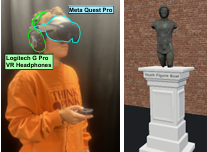 | Zubin Choudhary; Laura Battistel; Raiffa Syamil; Hiroshi Furuya; Ferran Argelaguet; Gerd Bruder; Gregory F. Welch Examining the Effects of Teleportation on Semantic Memory of a Virtual Museum Compared to Natural Walking Proceedings Article In: Proceedings of the International Conference on Artificial Reality and Telexistence and Eurographics Symposium on Virtual Environments (ICAT-EGVE 2024), Tsukuba, Japan, December 1-3, 2024, pp. 1-12, 2024. @inproceedings{Choudhary2024walking,
title = {Examining the Effects of Teleportation on Semantic Memory of a Virtual Museum Compared to Natural Walking},
author = {Zubin Choudhary and Laura Battistel and Raiffa Syamil and Hiroshi Furuya and Ferran Argelaguet and Gerd Bruder and Gregory F. Welch},
url = {https://sreal.ucf.edu/wp-content/uploads/2024/10/paper1028_2.pdf},
year = {2024},
date = {2024-12-01},
urldate = {2024-12-01},
booktitle = {Proceedings of the International Conference on Artificial Reality and Telexistence and Eurographics Symposium on Virtual Environments (ICAT-EGVE 2024), Tsukuba, Japan, December 1-3, 2024},
pages = {1-12},
abstract = {Over the past decades there has been extensive research investigating the trade-offs between various Virtual Reality (VR) locomotion techniques. One of the most highly researched techniques is teleportation, due to its ability to quickly traverse large virtual spaces even in limited physical tracking spaces. The majority of teleportation research has been focused on its effects on spatial cognition, such as spatial understanding and retention. However, relatively little is known about whether the use of teleportation in immersive learning experiences can effect the acquisition of semantic knowledge — our knowledge about facts, concepts, and ideas — which is essential for long-term learning. In this paper we present a human-subjects study to investigate the effects of teleportation compared to natural walking on the retention of semantic information about artifacts in a virtual museum. Participants visited unique 3D artifacts accompanied by audio clips and artifact names. Our results show that participants reached the same semantic memory performance with both locomotion techniques but with different behaviors, self-assessed performance, and preference. In particular, participants subjectively indicated that they felt that they recalled more semantic memory with walking than teleportation. However, objectively, they spent more time with the artifacts while walking, meaning that they learnt less per a set amount of time than with teleportation. We discuss the relationships, implications, and guidelines for VR experiences designed to help users acquire new knowledge.},
keywords = {},
pubstate = {published},
tppubtype = {inproceedings}
}
Over the past decades there has been extensive research investigating the trade-offs between various Virtual Reality (VR) locomotion techniques. One of the most highly researched techniques is teleportation, due to its ability to quickly traverse large virtual spaces even in limited physical tracking spaces. The majority of teleportation research has been focused on its effects on spatial cognition, such as spatial understanding and retention. However, relatively little is known about whether the use of teleportation in immersive learning experiences can effect the acquisition of semantic knowledge — our knowledge about facts, concepts, and ideas — which is essential for long-term learning. In this paper we present a human-subjects study to investigate the effects of teleportation compared to natural walking on the retention of semantic information about artifacts in a virtual museum. Participants visited unique 3D artifacts accompanied by audio clips and artifact names. Our results show that participants reached the same semantic memory performance with both locomotion techniques but with different behaviors, self-assessed performance, and preference. In particular, participants subjectively indicated that they felt that they recalled more semantic memory with walking than teleportation. However, objectively, they spent more time with the artifacts while walking, meaning that they learnt less per a set amount of time than with teleportation. We discuss the relationships, implications, and guidelines for VR experiences designed to help users acquire new knowledge. |
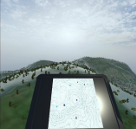 | Hiroshi Furuya; Zubin Choudhary; Jasmine Joyce DeGuzman; Matt Gottsacker; Gerd Bruder; Greg Welch Using Simulated Real-world Terrain in VR to Study Outdoor AR Topographic Map Interfaces Proceedings Article In: Proceedings of the International Conference on Artificial Reality and Telexistence and Eurographics Symposium on Virtual Environments (ICAT-EGVE 2024), Tsukuba, Japan, December 1-3, 2024, pp. 1-10, 2024. @inproceedings{Furuya2024topo,
title = {Using Simulated Real-world Terrain in VR to Study Outdoor AR Topographic Map Interfaces},
author = {Hiroshi Furuya and Zubin Choudhary and Jasmine Joyce DeGuzman and Matt Gottsacker and Gerd Bruder and Greg Welch},
url = {https://sreal.ucf.edu/wp-content/uploads/2024/10/cameraready_ICAT_EGVE_2024_1029_topographic_map.pdf},
doi = {tbd},
year = {2024},
date = {2024-12-01},
urldate = {2024-12-01},
booktitle = {Proceedings of the International Conference on Artificial Reality and Telexistence and Eurographics Symposium on Virtual Environments (ICAT-EGVE 2024), Tsukuba, Japan, December 1-3, 2024},
pages = {1-10},
abstract = {Augmented reality (AR) technology enables advanced integration of spatial information useful in a variety of important domains, including for reading topographic maps in the field. It is also important to understand how this technology may potentially affect spatial learning ability. In this paper, we demonstrate the use of virtual reality (VR) to conduct a human-subject study investigating the impacts of different simulated AR topographic map interface designs on spatial learning outcomes. Our results show that interfaces that encourage engagement with the interface instead of with the map and the environment result in fast task completion times but poor spatial learning. We also found participant preference for a novel interface design that assists users with map orientation without explicitly guiding the user through the task.},
keywords = {},
pubstate = {published},
tppubtype = {inproceedings}
}
Augmented reality (AR) technology enables advanced integration of spatial information useful in a variety of important domains, including for reading topographic maps in the field. It is also important to understand how this technology may potentially affect spatial learning ability. In this paper, we demonstrate the use of virtual reality (VR) to conduct a human-subject study investigating the impacts of different simulated AR topographic map interface designs on spatial learning outcomes. Our results show that interfaces that encourage engagement with the interface instead of with the map and the environment result in fast task completion times but poor spatial learning. We also found participant preference for a novel interface design that assists users with map orientation without explicitly guiding the user through the task. |
 | Matt Gottsacker; Hiroshi Furuya; Laura Battistel; Carlos Pinto Jimenez; Nicholas LaMontagna; Gerd Bruder; and Gregory F. Welch Exploring Spatial Cognitive Residue and Methods to Clear Users’ Minds When Transitioning Between Virtual Environments Proceedings Article In: IEEE International Symposium of Mixed and Augmented Reality (ISMAR), pp. 1-11, 2024. @inproceedings{nokey,
title = {Exploring Spatial Cognitive Residue and Methods to Clear Users’ Minds When Transitioning Between Virtual Environments},
author = {Matt Gottsacker and Hiroshi Furuya and Laura Battistel and Carlos Pinto Jimenez and Nicholas LaMontagna and Gerd Bruder and and Gregory F. Welch},
url = {https://sreal.ucf.edu/wp-content/uploads/2024/08/ISMAR24____Conference____Residue-5.pdf},
year = {2024},
date = {2024-10-21},
urldate = {2024-10-21},
booktitle = {IEEE International Symposium of Mixed and Augmented Reality (ISMAR)},
pages = {1-11},
abstract = {In most cases, retaining memories of things we have experienced in the past is desirable, but in some cases, we want to clear our minds so that we may focus completely on subsequent activities. When someone switches from one task to another, they commonly incur some “cognitive residue” where some of their cognitive resources such as working memory and attention remain devoted to their previous task even after they try to switch their focus to their new task. This residue could have a negative impact on their performance in the next task, and in such circumstances, it is important to reduce that residue. In this paper, we explore the concept of cognitive residue in the context of switching between virtual reality (VR) environments. We conducted a human-subject experiment (N=24) with a spatial recall task to investigate how different visual transitions might reduce participants’ spatial cognitive residue. In this instance, more errors on the recall task corresponds to less spatial cognitive residue. We found that transitions that lasted one minute successfully reduced spatial cognitive residue: they significantly reduced participants’ abilities to recall the positions of objects in their previous VE compared to an instantaneous cut transition. Additionally, for transitions that showed a nature scene, greater head movement significantly correlated with more spatial memory errors (i.e., less spatial cognitive residue). We discuss how these findings can be applied to support users transitioning between virtual tasks and environments in VR task switching scenarios.},
keywords = {},
pubstate = {published},
tppubtype = {inproceedings}
}
In most cases, retaining memories of things we have experienced in the past is desirable, but in some cases, we want to clear our minds so that we may focus completely on subsequent activities. When someone switches from one task to another, they commonly incur some “cognitive residue” where some of their cognitive resources such as working memory and attention remain devoted to their previous task even after they try to switch their focus to their new task. This residue could have a negative impact on their performance in the next task, and in such circumstances, it is important to reduce that residue. In this paper, we explore the concept of cognitive residue in the context of switching between virtual reality (VR) environments. We conducted a human-subject experiment (N=24) with a spatial recall task to investigate how different visual transitions might reduce participants’ spatial cognitive residue. In this instance, more errors on the recall task corresponds to less spatial cognitive residue. We found that transitions that lasted one minute successfully reduced spatial cognitive residue: they significantly reduced participants’ abilities to recall the positions of objects in their previous VE compared to an instantaneous cut transition. Additionally, for transitions that showed a nature scene, greater head movement significantly correlated with more spatial memory errors (i.e., less spatial cognitive residue). We discuss how these findings can be applied to support users transitioning between virtual tasks and environments in VR task switching scenarios. |
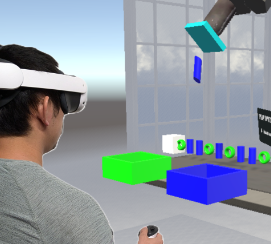 | Hiroshi Furuya; Laura Battistel; Zubin Datta Choudhary; Matt Gottsacker; Gerd Bruder; Gregory F Welch Difficulties in Perceiving and Understanding Robot Reliability Changes in a Sequential Binary Task Proceedings Article In: Proceedings of the 2024 ACM Symposium on Spatial User Interaction, pp. 1-11, Association for Computing Machinery, Trier, Germany, 2024, ISBN: 9798400710889. @inproceedings{Furuya2024perceive,
title = {Difficulties in Perceiving and Understanding Robot Reliability Changes in a Sequential Binary Task},
author = {Hiroshi Furuya and Laura Battistel and Zubin Datta Choudhary and Matt Gottsacker and Gerd Bruder and Gregory F Welch},
url = {https://sreal.ucf.edu/wp-content/uploads/2024/08/SUI_2024___Difficulties_in_Perceiving_and_Understanding_Robot_Reliability_Changes_in_a_Sequential_Binary_Task-1-2.pdf},
doi = {10.1145/3677386.3682083},
isbn = {9798400710889},
year = {2024},
date = {2024-10-07},
urldate = {2024-10-07},
booktitle = {Proceedings of the 2024 ACM Symposium on Spatial User Interaction},
pages = {1-11},
publisher = {Association for Computing Machinery},
address = {Trier, Germany},
series = {SUI '24},
abstract = {Human-robot teams push the boundaries of what both humans and robots can accomplish. In order for the team to function well, the human must accurately assess the robot’s capabilities to calibrate the trust between the human and robot. In this paper, we use virtual reality (VR), a widely accepted tool in studying human-robot interaction (HRI), to study human behaviors affecting their detection and understanding of changes in a simulated robot’s reliability. We present a human-subject study to see how different reliability change factors may affect this process. Our results demonstrate that participants make judgements about robot reliability before they have accumulated sufficient evidence to make objectively high-confidence inferences about robot reliability. We show that this reliability change observation behavior diverges from behavior expectations based on the probability distribution functions used to describe observation outcomes.},
keywords = {},
pubstate = {published},
tppubtype = {inproceedings}
}
Human-robot teams push the boundaries of what both humans and robots can accomplish. In order for the team to function well, the human must accurately assess the robot’s capabilities to calibrate the trust between the human and robot. In this paper, we use virtual reality (VR), a widely accepted tool in studying human-robot interaction (HRI), to study human behaviors affecting their detection and understanding of changes in a simulated robot’s reliability. We present a human-subject study to see how different reliability change factors may affect this process. Our results demonstrate that participants make judgements about robot reliability before they have accumulated sufficient evidence to make objectively high-confidence inferences about robot reliability. We show that this reliability change observation behavior diverges from behavior expectations based on the probability distribution functions used to describe observation outcomes. |