2026
|
 | Zubin Datta Choudhary; Lee Lisle; Ahinya Alwin; Gred Bruder; Greg Welch Cognitive Performance During Display Switching in Optical See-Through Augmented Reality Proceedings Article In: 25th IEEE International Symposium on Mixed and Augmented Reality (ISMAR), 2026. @inproceedings{Choudhary2026d,
title = {Cognitive Performance During Display Switching in Optical See-Through Augmented Reality},
author = {Zubin Datta Choudhary and Lee Lisle and Ahinya Alwin and Gred Bruder and Greg Welch },
url = {https://sreal.ucf.edu/wp-content/uploads/2026/10/cam-ready_DisplaySwitching_1.pdf},
year = {2026},
date = {2026-10-05},
urldate = {2026-10-05},
booktitle = {25th IEEE International Symposium on Mixed and Augmented Reality (ISMAR)},
journal = {25th IEEE International Symposium on Mixed and Augmented Reality (ISMAR)},
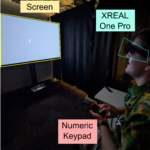
abstract = {Optical see-through (OST) augmented reality (AR) displays can render virtual content directly in the user's view of the physical world. In certain use cases, the physical world can include fixed emissive displays. For example, pilots, ship captains, and power plant operators equipped with AR displays might switch their visual attention between AR elements, physical interface components, and imagery on emissive flat panel displays fixed in the environment. Switching attention between these targets involves aspects of dynamic perception and cognition. We conducted a controlled study using XREAL One Pro AR glasses to examine the cognitive effects of switching attention between content displayed on a nearby flat panel display (FPD)/ screen and content displayed on a head-worn AR display (HWD), under two ambient brightness levels (10 lux and 150 lux). Participants completed an adapted Paced Visual Serial Addition Test (PVSAT), a continuous cognitive task that measures information processing speed and working memory under sustained demand, while switching between displays on every trial. Contrary to expectation, we found no general cost of switching over repeating a display. Instead, performance costs were specific to the direction of the transition: transitioning to the screen was significantly slower than transitioning to the HWD, no matter where the transition began. Higher ambient brightness improved response speed, reduced missed trials, and did not increase subjective visual fatigue. These findings suggest that in unpredictable multi-display environments, what display you transition to matters as much as the act of switching itself, with implications for the design of OST AR interfaces where transitions between head-worn and external displays are frequent. },
keywords = {},
pubstate = {published},
tppubtype = {inproceedings}
}
Optical see-through (OST) augmented reality (AR) displays can render virtual content directly in the user's view of the physical world. In certain use cases, the physical world can include fixed emissive displays. For example, pilots, ship captains, and power plant operators equipped with AR displays might switch their visual attention between AR elements, physical interface components, and imagery on emissive flat panel displays fixed in the environment. Switching attention between these targets involves aspects of dynamic perception and cognition. We conducted a controlled study using XREAL One Pro AR glasses to examine the cognitive effects of switching attention between content displayed on a nearby flat panel display (FPD)/ screen and content displayed on a head-worn AR display (HWD), under two ambient brightness levels (10 lux and 150 lux). Participants completed an adapted Paced Visual Serial Addition Test (PVSAT), a continuous cognitive task that measures information processing speed and working memory under sustained demand, while switching between displays on every trial. Contrary to expectation, we found no general cost of switching over repeating a display. Instead, performance costs were specific to the direction of the transition: transitioning to the screen was significantly slower than transitioning to the HWD, no matter where the transition began. Higher ambient brightness improved response speed, reduced missed trials, and did not increase subjective visual fatigue. These findings suggest that in unpredictable multi-display environments, what display you transition to matters as much as the act of switching itself, with implications for the design of OST AR interfaces where transitions between head-worn and external displays are frequent. |
 | Ahinya Alwin; Matthew Gottsacker; Hiroshi Furuya; Lee Lisle; Gerd Bruder; Gregory F. Welch Moving Towards Visibility Evaluation in Augmented Reality Using Simulated Environments and Continuous Psychophysics Proceedings Article In: Proceedings of the 2026 IEEE Conference on Virtual Reality and 3D User Interfaces Abstracts and Workshops (IEEE VRW): Third International Workshop on Perception-driven Graphics and Displays for VR and AR (PerGraVAR), 2026. @inproceedings{Alwin2026b,
title = {Moving Towards Visibility Evaluation in Augmented Reality Using Simulated Environments and Continuous Psychophysics},
author = {Ahinya Alwin and Matthew Gottsacker and Hiroshi Furuya and Lee Lisle and Gerd Bruder and Gregory F. Welch},
url = {https://sreal.ucf.edu/ieee_vr_2026_workshops_pergravar__visibility_evaluation_in_augmented_reality_using_simulated_environments_and_continuous_psychophysics_013026/},
year = {2026},
date = {2026-03-21},
urldate = {2026-03-21},
booktitle = {Proceedings of the 2026 IEEE Conference on Virtual Reality and 3D User Interfaces Abstracts and Workshops (IEEE VRW): Third International Workshop on Perception-driven Graphics and Displays for VR and AR (PerGraVAR)},
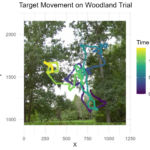
abstract = {Assessing the visibility of augmented reality (AR) cues in outdoor environments is challenging due to complex background structure, motion, and lighting variability. Simulating AR cues within virtual reality (VR) enables controlled manipulation and measurement of these factors while preserving immersive viewing conditions. This work presents a perception-driven methodology for evaluating AR cue visibility that combines simulated AR cues in VR, high resolution stereoscopic 360◦ video, and continuous psychophysics. Using this methodology, tracking-based performance data provide a continuous behavioral measure of visibility in complex scenes. Multiple analysis approaches are examined to support interpretation of tracking-based measures of perceptual performance in visually complex scenes. Together, this work illustrates progress toward a more ecologically valid and objective framework for studying AR cue visibility in outdoor settings.},
keywords = {},
pubstate = {published},
tppubtype = {inproceedings}
}
Assessing the visibility of augmented reality (AR) cues in outdoor environments is challenging due to complex background structure, motion, and lighting variability. Simulating AR cues within virtual reality (VR) enables controlled manipulation and measurement of these factors while preserving immersive viewing conditions. This work presents a perception-driven methodology for evaluating AR cue visibility that combines simulated AR cues in VR, high resolution stereoscopic 360◦ video, and continuous psychophysics. Using this methodology, tracking-based performance data provide a continuous behavioral measure of visibility in complex scenes. Multiple analysis approaches are examined to support interpretation of tracking-based measures of perceptual performance in visually complex scenes. Together, this work illustrates progress toward a more ecologically valid and objective framework for studying AR cue visibility in outdoor settings. |
 | Hiroshi Furuya; Jasmine Joyce DeGuzman; Zubin Datta Choudhary; Matt Gottsacker; Ahinya Alwin; Lee Lisle; Gerd Bruder; Gregory F Welch Effects of Multisensory Feedback and Real-World Priming on Presence and Copresence in Mixed Reality Drone Simulation Proceedings Article In: Proceedings of the 2026 IEEE Conference on Virtual Reality and 3D User Interfaces Abstracts and Workshops (IEEE VRW): 2nd Annual Workshop on Real and Virtual Spaces Influences (ReVISI), pp. 1-7, 2026. @inproceedings{furuya-real-world-priming-26,
title = {Effects of Multisensory Feedback and Real-World Priming on Presence and Copresence in Mixed Reality Drone Simulation},
author = {Hiroshi Furuya and Jasmine Joyce DeGuzman and Zubin Datta Choudhary and Matt Gottsacker and Ahinya Alwin and Lee Lisle and Gerd Bruder and Gregory F Welch},
url = {https://sreal.ucf.edu/wp-content/uploads/2026/02/VR26_Revisi__Real_World_Priming_for_VR_Experiences-3.pdf},
year = {2026},
date = {2026-03-21},
urldate = {2026-03-21},
booktitle = {Proceedings of the 2026 IEEE Conference on Virtual Reality and 3D User Interfaces Abstracts and Workshops (IEEE VRW): 2nd Annual Workshop on Real and Virtual Spaces Influences (ReVISI)},
pages = {1-7},
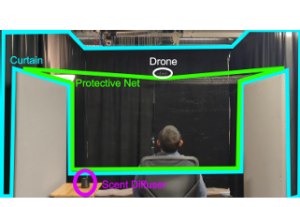
abstract = {Virtual reality (VR) experiences often rely on multisensory cues and realistic interactions to support convincing interpretations of virtual events and agents. This study examines how two factors, real-world priming and multisensory feedback, shape users’ perceptions of a virtual drone in a mixed-reality simulation. We conducted a mixed-design experiment where participants experienced either a physical drone flyover or no physical drone encounter, followed by audiovisual and multisensory drone flyovers in VR. Multisensory feedback increased co-presence and perceived realism specifically for participants who had encountered the real drone. In contrast, neither manipulation significantly affected standard presence measures. These findings highlight distinctions among presence-related constructs and suggest that recent real-world experiences can make certain multisensory cues be perceived as more realistic, even when they do not increase presence itself.},
keywords = {},
pubstate = {published},
tppubtype = {inproceedings}
}
Virtual reality (VR) experiences often rely on multisensory cues and realistic interactions to support convincing interpretations of virtual events and agents. This study examines how two factors, real-world priming and multisensory feedback, shape users’ perceptions of a virtual drone in a mixed-reality simulation. We conducted a mixed-design experiment where participants experienced either a physical drone flyover or no physical drone encounter, followed by audiovisual and multisensory drone flyovers in VR. Multisensory feedback increased co-presence and perceived realism specifically for participants who had encountered the real drone. In contrast, neither manipulation significantly affected standard presence measures. These findings highlight distinctions among presence-related constructs and suggest that recent real-world experiences can make certain multisensory cues be perceived as more realistic, even when they do not increase presence itself. |
 | Ahinya Alwin; Matthew Gottsacker; Hiroshi Furuya; Armin Delmo; Lee Lisle; Gerd Bruder; Gregory F. Welch [Poster] Can You See It? Evaluating Color Visibility in Simulated Outdoor Environments Proceedings Article In: Proceedings of IEEE Conference on Virtual Reality and 3D User Interfaces (IEEE VR) 2026., 2026. @inproceedings{Alwin2026_2,
title = {[Poster] Can You See It? Evaluating Color Visibility in Simulated Outdoor Environments},
author = {Ahinya Alwin and Matthew Gottsacker and Hiroshi Furuya and Armin Delmo and Lee Lisle and Gerd Bruder and Gregory F. Welch},
url = {https://sreal.ucf.edu/wp-content/uploads/2026/02/vr26b-sub1299-cam-i5.pdf},
year = {2026},
date = {2026-03-21},
urldate = {2026-03-21},
booktitle = {Proceedings of IEEE Conference on Virtual Reality and 3D User Interfaces (IEEE VR) 2026.},
journal = {Proceedings of IEEE Conference on Virtual Reality and 3D User Interfaces (IEEE VR) 2026, Daegu, South Korea.},
abstract = {Evaluating color visibility in outdoor augmented reality (AR) is challenging due to the visual complexity and variability of real world environments. Outdoor scenes feature diverse textures and lighting conditions, limiting the applicability of visibility evaluation methods developed for simple or static backgrounds. This work introduces a methodology for evaluating AR cue color visibility in an outdoor environment by sampling visibility across realistic scenes and identifying design considerations for evaluating color visibility under dynamic, visually complex conditions},
keywords = {},
pubstate = {published},
tppubtype = {inproceedings}
}
Evaluating color visibility in outdoor augmented reality (AR) is challenging due to the visual complexity and variability of real world environments. Outdoor scenes feature diverse textures and lighting conditions, limiting the applicability of visibility evaluation methods developed for simple or static backgrounds. This work introduces a methodology for evaluating AR cue color visibility in an outdoor environment by sampling visibility across realistic scenes and identifying design considerations for evaluating color visibility under dynamic, visually complex conditions |